A reflective coating fails when it is applied over damp plaster, chalking paint, salt deposits, or a wall that has not dried after cleaning. By following the preparation, application, quantity-checking, and inspection steps below, you can decide whether the coating suits your building and assess a quotation before work begins.
Key takeaways
- Repair leakage, rising damp, salts, loose plaster, and chalking before coating.
- Apply primer and finish coats within the manufacturer’s temperature and humidity limits.
- Calculate coverage from wall area, coats, porosity, and product data—not bucket size alone.
- Reject reflective coating when the wall has unresolved moisture or severe structural defects.
Inspect and prepare the Delhi wall before coating
Do not coat a Delhi wall until water entry and weak material have been removed. Inspect for rising damp, active leakage, salt deposits (efflorescence), loose plaster, chalking paint, oil, algae, smoke deposits, and dust.
Repair cracks, failed sealant joints, leaking parapets, and damp-proofing defects first; reflective paint cannot stop those faults, and coating over them causes blistering, peeling, or renewed salt staining.
- Remove loose plaster and peeling or chalking paint by scraping, brushing, or suitable mechanical preparation. Feather sound edges so the repair does not leave a ridge.
- Eliminate the water source: repair plumbing and parapet leaks, seal joints, and correct defective damp-proofing. Remove efflorescence with a dry brush before washing; do not trap salts beneath the coating.
- Wash the surface to remove dust, algae, oil, and smoke deposits. Use a compatible detergent for greasy contamination, rinse thoroughly, and allow all cleaning water to drain away from the wall.
- Fill stable cracks with a compatible exterior repair compound and renew failed sealant with an exterior-grade sealant. Replace hollow or badly damaged plaster rather than filling over it.
- Let the substrate dry completely before priming. Do not rely on a dry-looking surface: check damp patches and follow the coating manufacturer’s moisture limit.
Schedule heat reflective paint use in Delhi only when rain, fog, dew, and condensation are absent through the stated curing window. A shaded, sun-exposed façade offers more direct benefit than a damp or persistently shaded wall, which needs moisture control rather than paint alone.
Apply primer and finish coats under controlled conditions
Primer goes on only after the wall is clean, dry, sound, and free from settling dust. The heat reflective wall paint application process in Delhi must follow the product technical data sheet (TDS), because temperature, humidity, coverage, dry-film thickness, and curing limits vary by formulation.
- Remove loose paint, efflorescence, algae, oil, and smoke deposits; repair cracks and joints, then allow plaster or concrete to dry fully.
- Check the forecast and substrate. Do not apply during rain, fog, dew, condensation, heavy dust, or within the TDS rain-resistance window.
- Mix each component with a slow-speed mixer until uniform. Add water or thinner only in the quantity stated by the TDS; extra dilution reduces film thickness and reflectance.
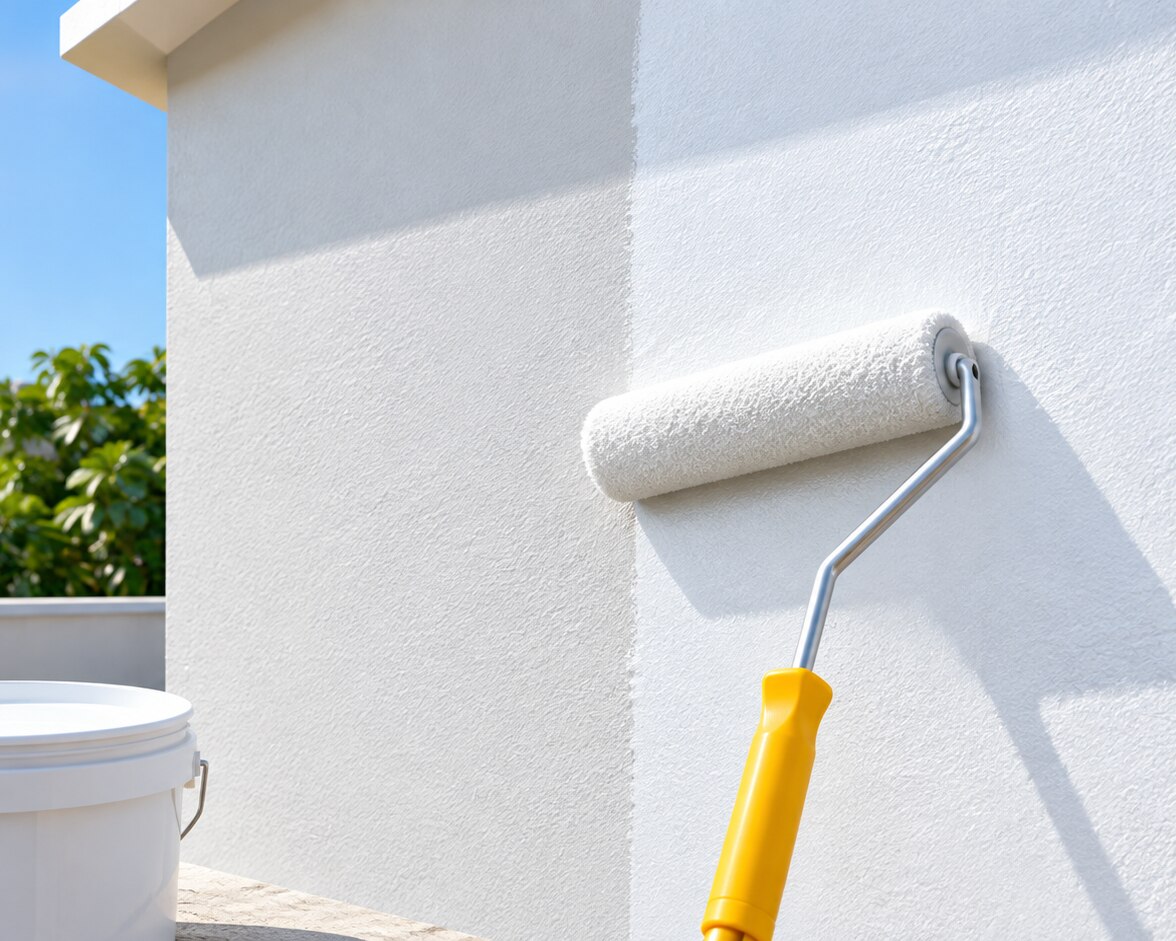
- Apply the compatible primer by brush, roller, or airless spray over the entire prepared surface. Do not coat a hot wall that causes rapid skinning or poor adhesion.
- Apply the first finish coat at the specified coverage, keeping the film even around edges, repairs, and texture. Let it dry for the stated recoat interval.
- Apply the second or additional finish coat only after the previous coat is firm and clean. Do not infer coat count from colour opacity; the system’s specified thickness controls performance.
- Protect the façade from rain, dew, dust, contact, and washing through final curing. Record batch numbers, coverage, weather, and recoat times for reflective wall paint application in Delhi.
White or light colours generally reflect more solar energy, but request solar-reflectance and thermal-emittance data for the selected colour. The cured coating is not a substitute for insulation or moisture repair.
Choose the right surface, coating system, and quantity
A wall heat reflective coating in Delhi belongs on a sound, dry surface, not over active dampness, peeling paint, or powdering plaster. Cement plaster, concrete, brick, and previously painted masonry can receive it after preparation; metal and waterproofed surfaces require a primer specifically approved for that substrate and finish system.
| Surface | Use the coating when | Primer or exclusion |
|---|---|---|
| Cement plaster | Sound, cured, dry, and free from dust | Masonry primer if specified |
| Concrete | Porous but structurally sound | Concrete-compatible primer |
| Brick | Stable, clean, and not salt-contaminated | Penetrating masonry primer |
| Previously painted wall | Existing film is firmly bonded | Compatibility test and suitable primer |
| Metal or waterproofed surface | Product data sheet confirms adhesion | Approved metal or waterproofing-compatible primer; exclude glossy, oily, or failing films |
Calculate quantity from the measured paintable area, the specified number of coats, and the manufacturer’s coverage in square metres per litre. Do not reduce coats because one colour looks opaque: the system’s dry-film thickness and reflectance depend on its formulated build. Add only the documented allowance for texture, porosity, spray loss, and touch-ups.
Ask for evidence for the actual product and colour, not a generic brochure:
- Solar reflectance and thermal emittance values, with the test method and report date.
- Required wet or dry-film thickness, coverage rate, recoat interval, and batch details.
- Adhesion and exterior durability results, including resistance to chalking, dirt, and weathering.
- Written limits for substrate moisture, temperature, humidity, and rain exposure during curing.
Control site conditions, quality checks, and monsoon maintenance
Keep the work zone cordoned off until the final coat is dry and access equipment is removed. Use warning signs, protect windows and parked vehicles, and keep occupants away from spray mist, wet surfaces, ladders, and scaffolds.
For heat reflective paint use in delhi, schedule exterior work only when the wall is dry and the product’s technical data sheet allows the temperature and humidity. Do not paint if rain, fog, dew, condensation, or heavy airborne dust is expected during the stated curing window.
Monsoon showers and winter fog can cause whitening, weak adhesion, or wash-off.
Before handover, record and inspect:
- Product batch and lot numbers
- Substrate condition, weather readings, and application dates
- Coverage or wet-film measurements for each coat
- Pinholes, holidays, runs, blistering, peeling, missed patches, and colour variation
- Adhesion results where specified: ASTM D3359 for comparative cross-hatch testing or ASTM D4541 for quantitative pull-off values
Do not allow normal occupancy until the coating has cured as specified, because early contact can mark the film and trap moisture. This documentation is part of a defensible reflective wall paint application in delhi, not optional paperwork.
Wash the façade when dust, soot, or biological growth builds up, using low-pressure water and a compatible mild detergent; avoid abrasive pads and aggressive pressure washing. Inspect cracks, joints, chalking, peeling, and impact damage after each monsoon, then clean, repair, prime, and locally recoat affected areas.
Base full recoating on exposure and tested durability, not a permanent-performance assumption.
Compare the quotation and identify when coating is the wrong choice
Compare quotations by the finished system, not by the price of a paint drum. A wall heat reflective coating in Delhi is the wrong choice when active leakage, rising damp, condensation, failed plaster, or inadequate insulation is the real cause of discomfort.
| Option | Compare in the quotation | When it applies |
|---|---|---|
| Reflective coating | Surface repairs, compatible primer, specified dry-film thickness, finish coats, access, curing protection | Sun-exposed façades with sound, dry walls |
| Exterior insulation | Insulation thickness, fixing method, render or cladding, thermal design | Indoor temperature control requires reduced conductive heat flow |
| Shading | Projection, screen material, fixing, wind loading, window coverage | Solar gain enters mainly through windows or the façade can be shaded |
| Waterproofing and repairs | Crack treatment, sealant joints, parapet details, damp-proofing, leak testing | Moisture is causing blistering, peeling, salt deposits, or mould |
Require the supplier to state the heat reflective wall paint application process in Delhi in measurable terms. Shiv Sales Corporation, or any bidder, should identify the exact product, batch, coverage per litre, primer, number of coats, recoat interval, required dry-film thickness, rain-resistance time, warranty exclusions, and who supplies scaffolding and protection.
Reject a quote that says “two coats” without coverage or film thickness, includes no preparation for chalking and efflorescence, or promises a fixed indoor-temperature reduction. Check the product technical data sheet against the proposed weather window; Delhi dust, monsoon rain, and winter dew can invalidate otherwise sound work.
Obtain dated photographs and written acceptance criteria before payment.
Related product
 | Heat Reflective wall paints Shiv Sales Corporation: Your Trusted Supplier of Heat Reflective Wall Paints in Delhi In the field of energy saving and thermal comfort, Shiv Sales... View product → |
Frequently asked questions
How should you prepare a Delhi wall before applying heat reflective paint?
Remove water entry first, then clean efflorescence, algae, smoke, oil, dust, chalking paint, loose plaster, and other weak material. Allow repairs and the wall to dry before priming.
What site conditions matter during reflective wall paint application in Delhi?
Check the wall and air temperature, humidity, rain forecast, dew, and direct sunlight. Follow the product data sheet for application limits, and stop work when rain or condensation threatens the uncured coating.
How do you calculate the quantity of heat reflective wall coating?
Measure the net wall area, subtract openings, multiply by the specified number of coats, and divide by the manufacturer’s coverage rate. Add allowance for porous or uneven surfaces after a trial area.
When is wall heat reflective coating in Delhi the wrong choice?
Do not use it as a cure for active leakage, rising damp, structural cracks, failing plaster, or contaminated surfaces. Resolve those defects first or choose a repair or waterproofing system instead.
Keywords