Contractors need more than a bottle price when selecting CICO No. 1: dosage, mixing sequence, application suitability, site controls and genuine stock all affect the result. By the end, you will be able to calculate the treated cement cost, brief your site team and compare Delhi dealer quotations without confusing an integral admixture with a complete waterproofing system.
Key takeaways
- Measure CICO No 1 against cement weight, not total concrete volume.
- Confirm the current label dosage and mixing sequence before batching.
- Run a trial batch before combining CICO with other admixtures.
- Compare dealers by treated cement cost, batch details and available stock.
Confirm the Dosage and Mixing Sequence Before Batching
Do not guess the dose from the phrase “integral liquid waterproofing compound in Delhi.” CICO No. 1 dosage must come from the current manufacturer’s label or technical literature and be measured against cement quantity, not casually against total concrete volume.
Ask for the stated quantity per 50 kg cement bag, then calculate the batch dose from the actual cement content.
1. Specify the use before ordering: RCC, plaster, masonry mortar, screed, repair mortar or water-retaining concrete. The correct mix design and dosage basis depend on the application.
2. Ask the cico waterproofing supplier for current manufacturer literature, the IS 2645-related test certificate, and written dosing instructions. Do not treat an online listing as proof, and do not exceed the published dose to chase extra waterproofing.
3. Measure the required liquid accurately. Do not pour an unmeasured quantity into the mixer or add extra water because the mix feels stiff; excess water raises porosity and permeability. Review the mix or use a compatible water-reducing admixture instead.
4. Dilute the measured CICO No. 1 in the gauging water, mix that solution thoroughly, and add it during batching with the cementitious materials. Never pour neat liquid onto dry cement, and never add it after placement has begun.
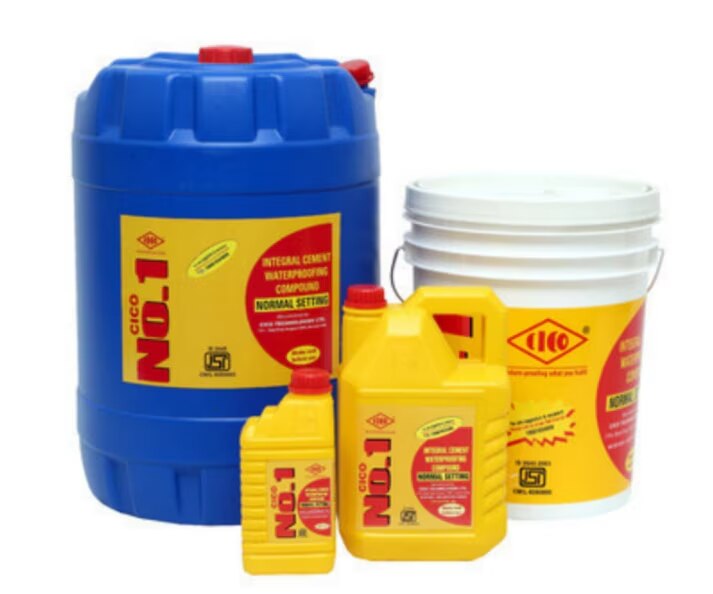
Confirm the product name, manufacturer marking, batch number, manufacturing date, shelf life and sealed pack before batching. These checks matter when selecting a cico no 1 waterproofing compound dealer in delhi.
Match the Admixture to the Cement-Based Application
CICO No. 1 is suited to cement concrete, mortar and plaster when the compound is mixed into the cementitious material. It can be specified for several construction stages, but the purchase order must name the application: plaster, masonry mortar, RCC, screed, water-retaining concrete or another defined use. Each requires different proportions, preparation and detailing.
| Application | Suitable use | Specify separately |
|---|---|---|
| RCC concrete | Basements, retaining walls, slabs and foundations | Concrete grade, water-cement ratio, cover, compaction and construction-joint treatment |
| Screed | Roof screeds, wet-area floors and bathroom sunken slabs | Falls, outlets, substrate bonding and movement-joint detailing |
| Plaster | External walls, below-grade walls and wet-area surfaces | Surface preparation, crack treatment, thickness and curing |
| Masonry mortar | Brick or block joints exposed to damp conditions | Joint fullness, wall junctions, coping and external surface protection |
| Water-retaining concrete | Tanks and other cement-based water-holding structures | Structural design, pour joints, waterstops and leak-testing procedure |
The admixture reduces capillary water penetration; it does not seal a structural crack, honeycombed concrete, an open construction joint or an active seepage path. Specify crack injection or repair mortar, joint treatment, drainage correction, or a separate membrane system for those defects.
Do not accept “integral liquid waterproofing compound” as a complete waterproofing specification. It describes the product category, not permission to omit curing, compaction, substrate preparation, joint detailing or surface-applied waterproofing where the design requires it.
Control Joints, Leaks and Concrete Quality on Site
Water resistance depends on the finished cement-based work, not the admixture alone. Keep the water-cement ratio controlled, compact every lift fully, and cure the concrete, mortar or plaster properly; excess water, trapped air and early drying leave connected pores that carry leakage.
Check these conditions before treating the work as waterproof:
- Use the specified cement content and water-cement ratio. Do not add water on site to restore slump or make plaster easier to spread.
- Compact concrete around reinforcement and into corners. Honeycombing creates a direct seepage path that an integral compound cannot seal.
- Maintain the specified concrete cover. Exposed or poorly protected reinforcement leads to cracking and water entry.
- Prepare the substrate by removing dust, laitance, loose mortar and standing water. Dampen absorbent surfaces without leaving a water film.
Treat every construction joint, control joint and pipe penetration as a separate detail. Provide the specified waterstop, sealant, swelling strip or repair mortar; the admixture does not bridge a moving joint or seal a defective cold joint.
Active seepage, structural cracks, honeycombing and inadequate drainage need repair or a separate waterproofing system. Do not bury them under plaster or screed. For basements, tanks, roofs and wet areas, record the joint layout, repair locations, curing method and drainage provision before accepting the treated surface.
Run a Trial Batch Before Combining Admixtures
Make a small batch with the exact cement, sand, aggregate, water and chemical admixtures planned for the work. Compare it with an untreated control mix; a trial that uses different materials can hide compatibility problems.
1. Check the container before batching. Record the product name, manufacturer marking, batch number, manufacturing date and shelf life. Reject leaking, unsealed or obsolete stock.
2. Measure the compound at the approved project dosage and dilute it uniformly into the gauging water. Do not pour neat liquid onto dry cement, add it after placement, or increase water to compensate for poor workability.
3. Mix the treated batch for the same duration and sequence planned on site. Check slump or flow, ease of placing, bleeding, segregation and dosage uniformity. Record the time from water addition to workable placement.
4. Observe setting behaviour. Note whether the treated mix sets significantly earlier or later than the control, because a changed setting window affects finishing, joints and compaction.
5. Cast trial specimens from both batches and cure them under the specified project conditions. Assess water absorption or penetration using the project’s nominated test method, then compare the treated result with the control.
6. Repeat the trial if cement type, mix proportions, water-reducing admixture or another chemical admixture changes. Approve full-scale placement only after the trial confirms workable mixing, acceptable setting and the required water-resistance performance. Keep the batch record and test results with the method statement.
Compare Delhi Dealers by Treated Cement Cost and Stock Proof
Compare quotations by the cost of treating 50 kg of cement, not by the lowest bottle or drum price. A search for “CICO No. 1 price in Delhi” is incomplete until the quotation states pack size, dosage from current manufacturer literature, GST, freight, unloading, wastage and delivery location.
| Dealer | Price evidence | Stock proof |
|---|---|---|
| Local dealer | Dated, tax-inclusive quote showing landed cost per 50 kg cement treated | Sealed pack, batch number, manufacturing date and shelf life |
| Marketplace listing | Display price with unclear GST, freight or dosage | Treat as a lead, not compliance evidence |
| CICO waterproofing supplier | Project-rate quote tied to the specified application and quantity | Current test certificate or manufacturer literature, product marking and invoice |
Before choosing a CICO No. 1 Waterproofing Compound Dealer in Delhi, request these documents and inspect the stock:
- Product name and manufacturer marking must match the quotation; reject relabelled containers.
- Record the batch number, manufacturing date and expiry or shelf-life statement.
- Check that seals are intact and containers show no leakage, swelling or damaged labels.
- Ask whether the quoted batch is physically available, not merely “arranged after order.”
- Confirm the literature identifies the compound for your use—plaster, masonry mortar, RCC, screed or water-retaining work—and references IS 2645 where claimed.
If you plan to buy CICO No. 1 in Delhi, Shiv Sales Corporation should provide the same batch, dosage basis and tax details you use to compare another dealer. A genuine quote is still unsuitable if it describes the material as a membrane or surface coating.
Related product
 | CICO No. 1 – Integral Liquid Waterproofing Compound CICO No. 1 – Integral Liquid Waterproofing Compound CICO No. 1 from Shiv Sales Corporation is a high-quality liquid waterproofing compound designed to enhance the durability and strength of cement... View product → |
Frequently asked questions
How should you confirm the dosage of CICO No 1?
Use the current manufacturer’s label or technical literature, then measure the dose against the cement quantity. Do not estimate it from total concrete volume.
Why does the cement-based application matter when selecting an admixture?
Concrete, plaster, mortar and repair work have different cement contents, water demand and placement conditions. Match the product instructions to the specific application.
What site conditions affect waterproofing performance?
Control construction joints, cracks, leaks, curing and concrete quality. An admixture cannot compensate for honeycombing, poor compaction or an uncontrolled joint.
Why run a trial batch before combining admixtures?
A trial batch lets you check workability, setting behaviour, finish and compatibility before full production. Test combined admixtures instead of assuming they will work together.
How should you compare CICO No 1 dealers in Delhi?
Compare the cost per treated quantity of cement, not only the pack price. Ask for current stock proof, batch details, manufacturer literature and clear dosage guidance.
Keywords