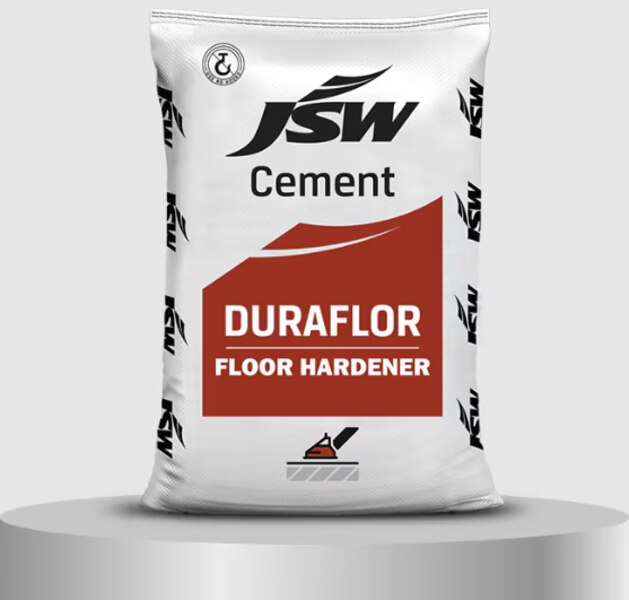
Contractors do not spread dry-shake hardener onto a cured slab or use it to soak up standing bleed water. They broadcast it onto fresh concrete at the correct finishing stage, then incorporate, finish, cure, and joint the surface without compromising the slab beneath. By the end, you will know how to judge slab readiness, calculate material, select the hardener type, and check whether the finished floor is fit for its traffic.
Key takeaways
- Broadcast hardener only after bleed water disappears and the concrete reaches initial set.
- Calculate powder coverage from slab area, application rate and the number of broadcast passes.
- Use non-metallic hardener for general traffic; assess metallic grades for severe abrasion and impact.
- Protect curing concrete, saw-cut joints on schedule and inspect for dusting, cracks and delamination.
How contractors broadcast and finish hardener on fresh concrete
1. Place the concrete continuously, then screed and level it to the designed profile. Wait through the initial set until bleed water has evaporated; never broadcast onto standing water or scatter powder to absorb it, because that creates a weak, water-rich interface that can dust, delaminate or peel.
2. Divide the specified hardener quantity into application portions. Spread the first portion evenly across the slab, keeping the broadcast rate consistent at edges and around columns. Let the powder darken as it draws moisture from the concrete, then float it into the surface without overworking the paste.
3. Apply the second broadcast at right angles to the first so dry patches and heavy bands are reduced. As the concrete becomes firm, use mechanical finishing to incorporate the material and close the surface.
Judge this finishing window by surface condition, not clock time: the slab must accept a worker’s footprint without deep marking while retaining enough plasticity for incorporation.
4. Make the final closing pass only after the surface supports the machine without tearing or bringing excess paste upward. Premature power-trowelling traps bleed water beneath the hardener and can seal a weak layer into the slab.
This sequence is the practical core of floor hardener applications in delhi, where heat, wind and winter temperatures can shift the timing substantially.
How to prepare the slab before the powder reaches it
Use concrete with the cement content and strength grade required by the structural design. Control the water-cement ratio, keep slump consistent between loads, and prohibit unapproved water additions at site; extra water can leave a weak, dusty surface even when the hardener dosage is correct.
The hardener cannot repair inadequate slab thickness, poor subgrade support, weak reinforcement or badly located joints. Resolve those design and construction defects before pouring.
- Remove bleed water by waiting, squeegeeing or using approved methods; never broadcast powder onto standing water.
- Reject or correct loads showing segregation, because paste-rich and aggregate-rich zones finish differently.
- Plan placement to avoid delays between truckloads; delayed concrete can develop cold joints or lose the finishing window.
- Start only when the surface supports a worker without a deep footprint, while remaining plastic enough to accept incorporation.
| Condition | Required control | Failure risk |
|---|---|---|
| Hot, dry or windy Delhi weather | Shade the slab, block direct sun and wind, and reduce evaporation | Plastic-shrinkage cracks and premature crusting |
| Winter weather | Allow for slower setting and extend supervision of the finishing window | Hardener applied too early or too late |
| Unfamiliar mix, weather, equipment or crew | Complete a trial panel before production | Unpredictable colour, texture or bond |
A floor hardener for concrete contractors depends on the concrete and finishing crew as much as on the powder. Require a trial panel and record the actual broadcast time, concrete temperature, weather, slump and finishing equipment.
How to calculate coverage and choose metallic or non-metallic hardener
Calculate bags from the dry-shake rate, not from slab thickness:
Required bags = (floor area in m² × application rate in kg/m² × wastage multiplier) ÷ bag size in kg.
Use about 3–5 kg/m² for moderate industrial traffic and about 5–7.5 kg/m² where forklifts, severe impact or point loading govern, then confirm the product data. A 5% allowance uses a 1.05 multiplier; round the result up to whole bags. Slab thickness determines concrete volume and structural design, but it does not automatically determine dry-shake dosage.
| Option | What it means | When it applies |
|---|---|---|
| Non-metallic mineral or quartz | Clean appearance, strong abrasion resistance, low rust-staining risk and no metallic conductivity | Ordinary warehouses, forklift aisles and floors where electrical requirements matter |
| Metallic aggregate | Higher resistance to severe impact and concentrated point loading; darker industrial appearance | Heavy-duty loading zones after checking oxidation, wet-service corrosion and finishing controls |
Specify more than a price per bag. Compare the same kg/m² rate, bag size and wastage allowance, then check the aggregate type, abrasion-performance data and electrical requirements. Metallic hardener can leave finishing defects if the crew closes the surface poorly, while wet service can expose corrosion risk.
For high strength floor treatment in Delhi, treat coverage and aggregate selection as one specification decision. Ask for batch traceability and written application limits before ordering.
Which floor system fits aisles, ramps, loading bays and chemical areas
Specify non-metallic dry-shake hardener for ordinary pallet warehouses, forklift aisles, parking decks, ramps and general manufacturing floors where rust staining and electrical conductivity matter. For loading bays with severe impact or concentrated point loads, consider metallic hardener only after checking moisture exposure, corrosion risk and the required finish.
| System | Best fit | Key limits |
|---|---|---|
| Non-metallic dry-shake | Warehouses, aisles, ramps, parking decks and general floors | Applied to fresh concrete; mineral or quartz aggregate reduces rust-staining risk |
| Metallic dry-shake | Severe impact and concentrated point loading at loading bays | Check oxidation, wet-service corrosion, conductivity and finishing defects |
| Lithium- or sodium-silicate densifier | Cured concrete needing dust control and surface densification | Does not create the build thickness or chemical barrier of a topping |
| Epoxy or polyurethane topping | Chemical areas and floors needing a resin barrier | Requires moisture testing, surface preparation and planned repairs; specify slip-resistant texture |
A dry-shake hardener must be incorporated while fresh concrete remains workable. A silicate densifier treats cured concrete, while epoxy and polyurethane toppings form separate resin layers; installation timing, chemical resistance, repairability, slip resistance and moisture tolerance differ sharply.
Before buying an industrial floor hardener in delhi, ask a floor hardener supplier in delhi for:
- Coverage in kg/m², aggregate type and abrasion or compressive-performance data
- Compatible concrete grade, timing window, curing instructions and joint-treatment guidance
- Batch traceability and the stated moisture or chemical limitations
Compare quotations at the same dosage, bag size and wastage allowance. Shiv Sales Corporation can help connect the selected material with technical guidance for a Delhi installation, rather than quoting powder alone.
Related product
 | Floor Hardener – High-Strength Industrial Floor Treatment Floor Hardener – High-Strength Industrial Floor Treatment Floor Hardener from Shiv Sales Corporation is a premium, ready-to-use metallic or non-metallic surface hardener designed to increase the durability... View product → |
How to protect, joint and accept the finished industrial floor
A glossy power-trowelled surface does not prove a high-performance floor. Protect, joint and accept the slab in this order:
1. Apply the curing method approved for the selected hardener immediately after finishing. Protect the surface from traffic, rapid drying, rain and contamination for the stated curing period. Hardener cannot stop shrinkage cracks caused by inadequate curing.
2. Saw-cut contraction joints at the designed time: late cutting allows random cracks, while early cutting can ravel the edges. Follow the joint layout and required depth; do not improvise spacing after the slab is finished.
3. Detail other movement points separately. Form construction joints at planned pour breaks, provide full-depth isolation joints around columns, walls and fixed equipment, and continue suitable joint treatment around drains. Detail door thresholds for movement, level changes, water control and traffic impact rather than cutting them into the nearest bay.
4. Before applying epoxy, sealer, adhesive flooring or line marking, confirm that the curing membrane is compatible with the planned finish. An incompatible membrane can prevent later adhesion. Keep cementitious bags dry, off the floor and within the stated shelf life; reject damp, partially set powder or bags containing lumps.
5. Accept the floor against pre-agreed criteria: uniform coverage and colour, no dusting or delamination, sound joint edges, agreed flatness, acceptable appearance, and specified abrasion or traffic performance. Inspect the finished floor after curing, not only under the trowel’s shine.
Frequently asked questions
When should contractors broadcast floor hardener on fresh concrete?
Broadcast it after screeding and levelling, once initial set has started and all bleed water has evaporated. Never spread powder over standing water.
How do contractors calculate floor hardener coverage?
Multiply the slab area by the specified application rate, then allow for the planned number of broadcast passes and site wastage. Confirm the rate on the product technical data sheet.
When should a contractor choose metallic instead of non-metallic floor hardener?
Choose non-metallic hardener for general industrial traffic and metallic hardener where the floor faces severe abrasion, impact or concentrated wheel loads. Confirm compatibility with the concrete mix and exposure.
How should an industrial floor be accepted after finishing?
Check the finished surface for uniform texture, dusting, delamination, cracks, incorrect levels and damaged joints. Confirm curing, joint layout and protection before permitting heavy traffic or chemical exposure.
Keywords