

XPS and ceramic board are not interchangeable insulation grades: XPS targets low-temperature building-envelope heat loss, while ceramic-fibre products address hot equipment, fire exposure, and extreme service temperatures. By comparing the material forms, Delhi shed conditions, installation details, and location-specific risks, you can choose one material, or a hybrid build-up, without overloading a metal structure or creating a fire hazard.
Key takeaways
- Identify whether “ceramic board” means ceramic fibre, refractory, microporous, or fired ceramic block.
- Use XPS where moisture resistance and compressive strength matter, not as a high-temperature fire barrier.
- Reserve ceramic fibre or refractory board for equipment zones exposed to elevated temperatures.
- Specify thickness, density, facing, joints, fixings, and fire test documents before ordering.
What “ceramic board” means beside XPS
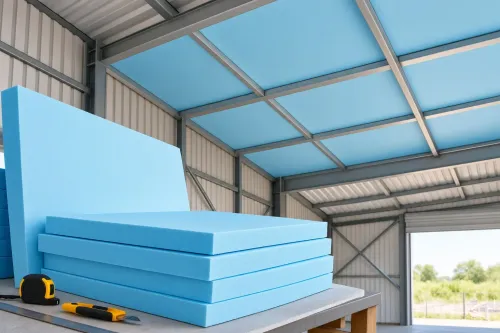
“Ceramic board” can mean three different products: ceramic-fibre board, a rigid refractory or microporous board, or a fired ceramic block. XPS is a closed-cell polymer foam, not a ceramic substitute.
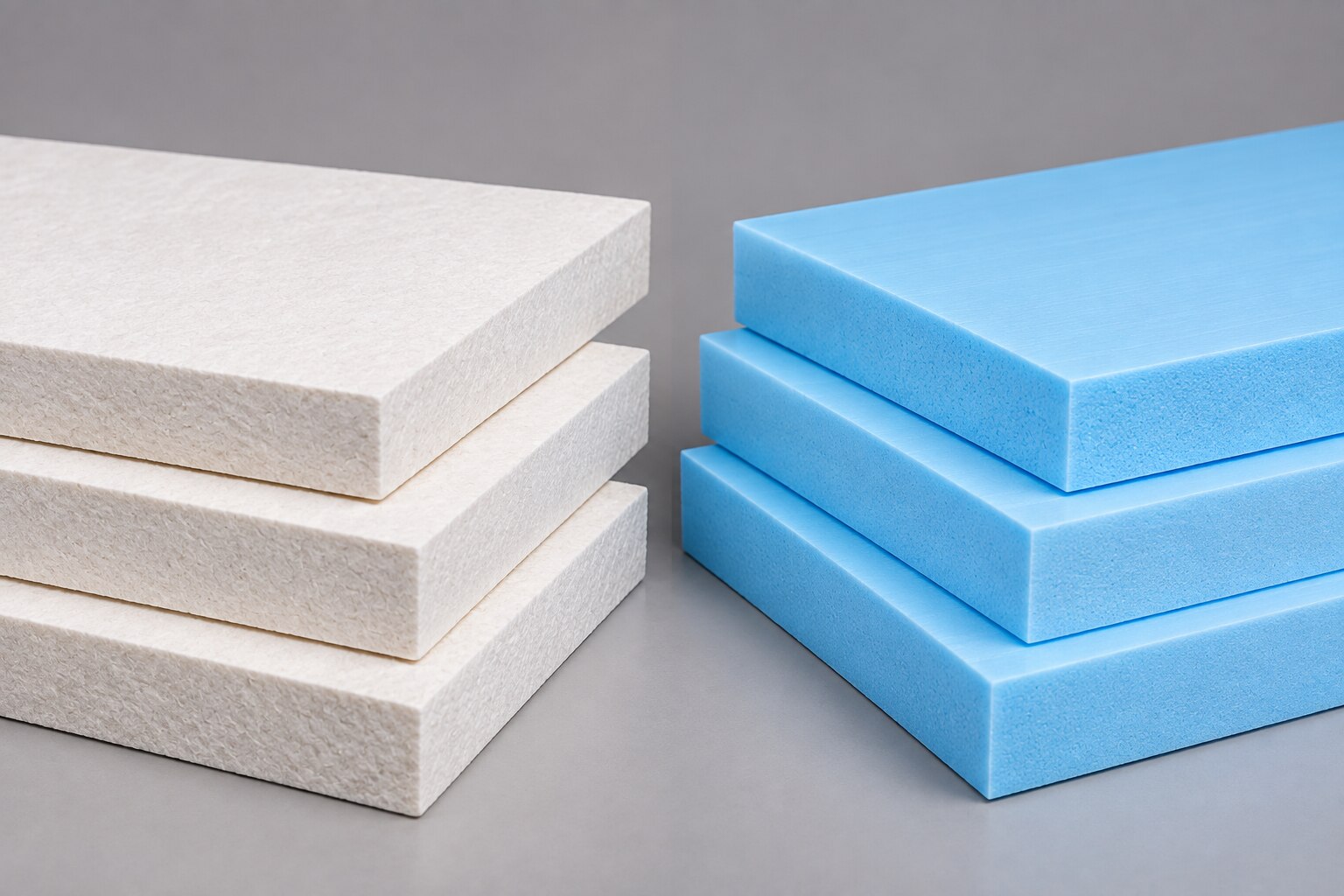
For an xps board shed insulation comparison, representative design conductivity is about 0.029–0.036 W/m·K for XPS and 0.05–0.12 W/m·K for ceramic-fibre board, depending on density, mean temperature, and manufacturer. A 50 mm XPS layer can therefore provide greater thermal resistance than 50 mm of ceramic-fibre board at ordinary shed temperatures.
| Material | Service and thermal behaviour | Physical and maintenance implications |
|---|---|---|
| XPS board | About 70–75°C service limit; low conductivity; combustible | Lightweight, good compressive strength, closed-cell and low water uptake; protect from UV, impact, fire, and solvents |
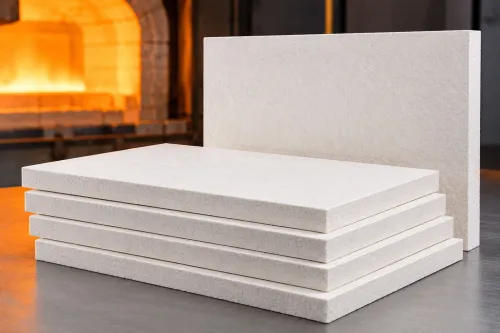
| Ceramic-fibre board | Common grades around 1,000–1,430°C; higher conductivity at ambient temperature | Very light but weak in compression and vulnerable to impact, wetting, edge breakage, and fibre erosion; needs facing or protection |
| Rigid refractory or microporous board | High-temperature use; conductivity depends strongly on formulation and temperature | Denser and more brittle; specify strength, joints, and handling method |
| Fired ceramic blocks | Masonry or refractory construction, not lightweight insulation | Heavy, strong, impact-resistant, moisture-tolerant, but adds substantial dead load |
1. Choose XPS for a normal roof or wall when the assembly keeps it below its temperature limit and protects it from fire, sunlight, and damage.
2. Choose ceramic-fibre board beside furnaces, hot ducts, exhausts, or spark-producing work.
3. Ceramic blocks for shed insulation suit masonry, refractory construction, or a fire-rated enclosure—not a lightweight metal roof unless added structural support is designed.
How Delhi heat, monsoon moisture, and fire exposure change the decision
For ceramic board versus XPS board for shed insulation in Delhi, choose XPS only when the roof build-up keeps it below its service limit and protects it from fire, ultraviolet exposure, and condensation. Roof-sheet temperature matters more than weather-station air temperature: a dark, unventilated metal roof can become far hotter under direct sun.
A ventilated cavity, reflective outer surface, or external shading reduces that load before you change insulation type.
| Material | Approximate service range | What the figure does not prove |
|---|---|---|
| XPS | 70–75°C in many products | It is combustible and the temperature limit is not a fire rating |
| Ceramic-fibre board | About 1,000–1,430°C by grade | The rating is not proof of ambient-temperature insulation or assembly fire resistance |
For ceramic board shed insulation in Delhi, use a documented high-temperature system near furnaces, flues, chimneys, hot surfaces, exhausts, spark-producing work, or required non-combustible linings. Do not assume exposed XPS is suitable in those zones, or beside solvents and unprotected sunlight during storage or installation.
- Protect XPS with a suitable lining and separate it from ignition sources.
- Check the complete roof or wall assembly for documented fire performance; ASTM C578 classification alone does not make an installation fire-safe.
- Treat low water absorption as a material property, not roof waterproofing. Provide flashing, drainage, vapour control, and condensation design; monsoon moisture can still wet ceramic board and damage its performance.
Which material fits the roof, wall, ceiling, partition, or equipment zone
A normal conditioned warehouse or workshop roof usually favours XPS, provided the assembly keeps it below its 70–75°C product limit, shields it from ultraviolet light and fire, and includes waterproofing, vapour control, and condensation detailing.
| Location | Dominant requirement | Better fit and conditions |
|---|---|---|
| Roof | Low heat flow with controlled temperature | XPS suits a protected roof build-up; use ceramic-fibre board where solar temperatures, ignition, or a non-combustible lining exceed the XPS design. |
| Wall or ceiling | Impact, moisture, joints, and surface protection | XPS needs a durable liner and sealed joints. Ceramic-fibre board needs a weather-facing or protective liner because moisture, impacts, edge breakage, and fibre erosion reduce its service. |
| Internal partition | Thermal separation or sound control | XPS separates temperature, not sound. Thin XPS and ordinary ceramic board are incomplete acoustic systems; use mass, decoupling, sealed junctions, and a tested absorber or perforated liner. |
| Furnace room, boiler, hot duct, exhaust, or spark area | High-temperature and fire protection | Choose ceramic-fibre board or another documented high-temperature system. Do not expose XPS near hot surfaces, sparks, flames, or exhausts. |
| Equipment enclosure | Temperature, fire, and maintenance access | Use ceramic protection around heat-producing equipment; use XPS only in cool, separated envelope zones. |
For ceramic board shed insulation in Delhi, match the board to the zone rather than lining the whole shed with it. Ceramic blocks for shed insulation are rarely practical on lightweight roofs or walls: their dead load can require stronger purlins, girts, and foundations.
A local ceramic barrier with XPS across ordinary envelope areas is often the more efficient design.
Installation details that decide the real performance
Installation details decide the shed’s heat flow more than the catalogue conductivity alone. Purlins, girts, screws, brackets, laps and service penetrations create thermal bridges that can make the installed U-value far higher than the centre-of-board figure.
Lay boards continuously across the framing where the build-up allows it, stagger joints, seal every joint, and close cut edges. In an xps board shed insulation comparison, remember that closed-cell foam still admits moisture through open joints, penetrations and condensation paths. XPS is not a roof membrane.
Ceramic-fibre board needs equal care. Water can reduce its effective insulation performance, while handling and exposure can cause edge breakage, fibre erosion and surface damage.
Before approving the design, check:
- Request the calculated or tested installed-build-up U-value, not only the board datasheet conductivity.
- Verify roof drainage, laps, flashings and penetrations so leaks cannot reach the insulation.
- Place the vapour-control layer on the correct warm-side location for the conditioned space, and check condensation on cold metal members.
- Specify protective facings, impact protection and a fire-rated liner where the assembly requires them.
Do not treat insulation as acoustic treatment. Reverberation control needs a protected absorber, acoustic blanket or tested perforated liner. Sound transmission through metal walls and roofs needs mass, decoupling and sealed junctions; thin XPS and ordinary ceramic board provide neither complete system.
How to specify industrial shed insulation materials in Delhi
Specify industrial shed insulation materials in Delhi as an installed build-up, not a product name. State the exact form—XPS board, ceramic-fibre board, rigid refractory board, or block—and the zone, because ceramic board versus XPS board for shed insulation in Delhi is a location decision.
- Thickness, density, and declared conductivity at a stated mean temperature.
- Maximum service temperature and compressive property, including test direction.
- Water-absorption test and result.
- Facing, edge profile, joint treatment, and UV protection.
- Fire classification or test report for the complete assembly.
- Adhesive, fastener, washer, and protective-lining compatibility.
- Installation method, support spacing, vapour-control position, and sealing details.
- For XPS, the applicable ASTM C578 product classification.
- For ceramic-fibre board, formulation, rated temperature, binder behaviour, and facing details.
- For ceramic board, the actual fire-test or classification report, including supports and coatings.
| Option | Procurement check | Suitable decision |
|---|---|---|
| XPS | ASTM C578 class plus separate assembly fire documentation; ASTM C578 alone does not make an installation fire-safe | Ordinary roof and wall envelope areas below the product temperature limit |
| Ceramic-fibre board | Formulation, binder, facing, rated temperature, and complete fire report | Furnace, duct, exhaust, spark, and non-combustible lining zones |
| Hybrid | XPS in protected envelope areas and ceramic board at verified hot zones | Lower cost without extending high-temperature material throughout |
Use XPS across ordinary envelope areas and ceramic protection locally when the design supports that split. Shiv Sales Corporation can compare options against your roof build-up, hot zones, moisture exposure, and required protective layers rather than the product name alone.
Related products
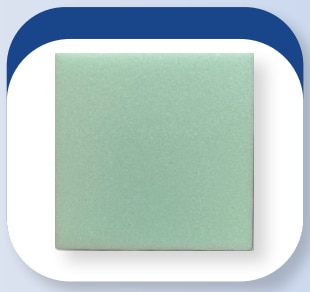 | Extruded Polystyrene Sheet (XPS Board) – High-Performance Thermal Insulation Extruded Polystyrene Sheet (XPS Board) – High-Performance Thermal Insulation XPS Board from Shiv Sales Corporation is a rigid, moisture-resistant thermal insulation sheet designed for roofs, walls, floors, and foundation... View product → |
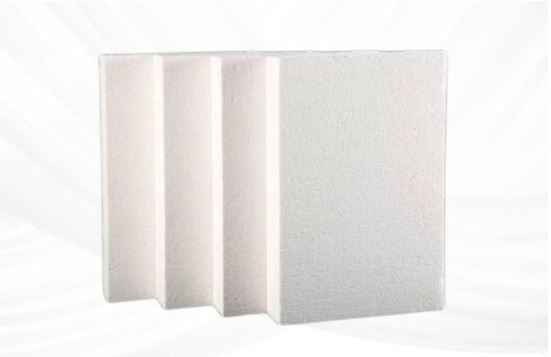 | Ceramic Product Unveiling the Excellence: Ceramic Products In the field of insulation materials, ceramic products play an important role in providing... View product → |
Frequently asked questions
What does ceramic board mean compared with XPS board?
Ceramic board can mean ceramic-fibre board, refractory or microporous board, or fired ceramic block. XPS is a closed-cell polymer foam insulation board, so the products serve different temperature and construction requirements.
How do Delhi heat and monsoon moisture affect the choice?
For roof and wall assemblies, assess solar heat, condensation, rain entry, vapour control, and drainage together. XPS resists liquid-water absorption, while ceramic products require careful protection from moisture and impact during installation.
Where should you use XPS in an industrial shed?
Use XPS where a rigid, moisture-resistant board is needed in roof, wall, floor-edge, or below-grade assemblies, provided the assembly’s fire requirements allow it.
Where should you use ceramic board?
Use ceramic-fibre or refractory board around high-temperature equipment and heat-exposed zones after checking its service-temperature rating. Do not treat fired ceramic blocks as a direct substitute for lightweight insulation board.
What should an insulation specification for a Delhi shed include?
State the material type, thickness, density, thermal conductivity, service-temperature limit, water absorption, compressive strength, fire-test classification, facing, joint treatment, fixings, and installation location.
Related product
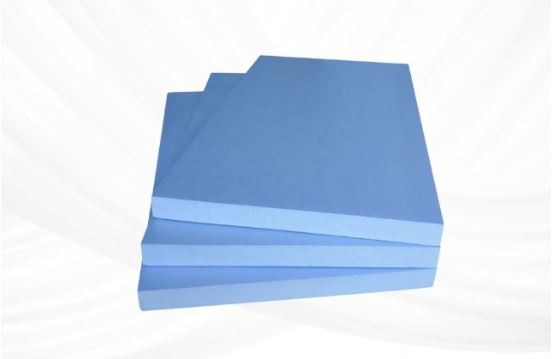 | Extruded Polystyrene Sheets Shiv Sales Corporation offers high-quality and cost-effective extruded polystyrene foam designed to meet various insulation requirements. View product → |