Wet fill, Yamuna floodplain silt, dense alluvium, and Delhi Ridge soils do not place the same demands on a geotextile. By matching the fabric to the soil, water movement, loading, and installation conditions, you can prevent aggregate loss, maintain drainage paths, and reduce monsoon-related erosion instead of relying on GSM or tensile strength alone.
Key takeaways
- Investigate the subgrade and proof-roll before selecting geotextile.
- Match woven or nonwoven fabric to separation, reinforcement, filtration, or drainage duties.
- Check puncture resistance and installation survivability against site conditions.
- Request test data, batch identification, and technical support from Delhi suppliers.
Why Delhi ground conditions change the geotextile requirement
A fabric that performs on dense older alluvium can rut, extrude, or clog when placed over wet silt, uncontrolled fill, or soft floodplain ground. Select it only after a site investigation and construction-stage proof-rolling reveal the actual subgrade condition.
| Ground condition | Main concern | Selection consequence |
|---|---|---|
| Uncontrolled fill | Variable density, debris, and sharp inclusions | Use a robust separator and remove objects that could puncture it |
| Delhi Ridge soils | Stony, irregular surfaces and runoff concentration | Prioritise puncture resistance, surface trimming, and erosion control |
| Older alluvial deposits | Denser, more uniform bearing layer | Separation or filtration may govern rather than maximum tensile strength |
| Yamuna floodplain ground | Soft, wet silt and high rutting risk | Use a separator suited to weak subgrade and provide staged aggregate placement |
A specification for geo textile for soil stabilization in Delhi must match the structure and failure risk. For roads, parking areas, utility corridors, and construction platforms, place separation fabric beneath granular sub-base.
For retaining walls, basements, bridge approaches, and road-edge drains, use fabric between soil and drainage aggregate or a drainage composite; it cannot replace a continuous drain, graded outlet, or waterproofing.
Geo textile applications in Delhi also include monsoon protection for channels, embankment toes, slopes, and low-lying sites. Nonwoven needle-punched fabric commonly serves filtration, while woven products suit high tensile demand; neither choice is automatic. An exposed fabric can be damaged by loaded vehicles, and a drainage outlet blocked by silt can leave hydrostatic pressure unchanged.
How geotextile stabilizes weak subgrade and survives installation
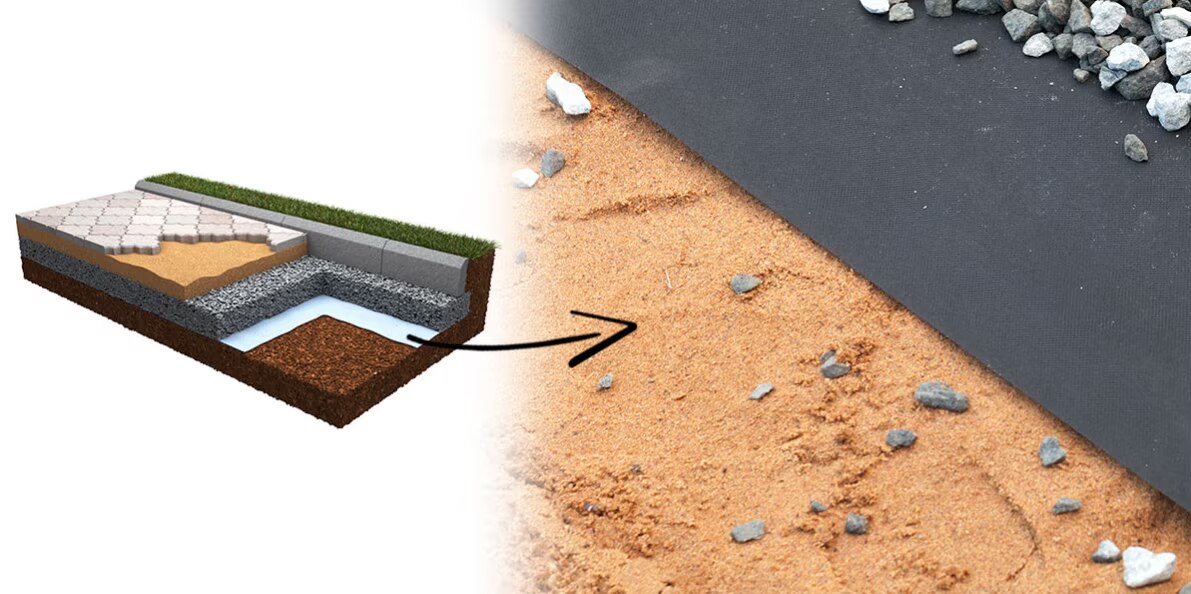
Place the fabric between trimmed weak subgrade and granular sub-base: it separates soil, lets water pass, and stops aggregate from punching into clay. The preserved aggregate thickness spreads wheel loads over a wider area and limits rutting.
Separation alone does not increase bearing capacity; claim reinforcement only when tensile interaction, aggregate confinement, rut-depth limits, and installation survivability are included in the design.
- Trim the subgrade to the specified line and level, remove standing water, roots, and sharp stones, and fill soft pockets before laying the fabric.
- Unroll it wrinkle-free in the direction of construction traffic. Use at least a 300 mm overlap unless the design requires more, and increase the overlap on very soft ground.
- Anchor edges and overlaps with pins or suitable ballast so wind, water, and aggregate placement cannot shift the sheet.
- Treat seams as specified: sewn seams provide a designed connection; an unplanned loose overlap can open under trafficking.
- Place granular material by end-dumping onto covered areas, then spread it forward. Do not drive loaded trucks, dumpers, or compactors directly on exposed fabric.
- Maintain enough cover before construction traffic begins. Inspect for punctures, tears, exposed edges, and displaced overlaps, then patch damage with fabric extending beyond the defect.
For geo textile for soil stabilization in Delhi, compare installation survivability rather than GSM alone. Check grab tensile strength, trapezoid tear, puncture resistance, and seam performance using named test methods; a headline tensile value from an undamaged sample does not predict resistance to stone impact or ripping during placement.
How geotextile filters drainage and controls erosion
A filter geotextile lets water pass toward a perforated pipe, drainage aggregate, or channel while holding back soil particles. Place it between the protected soil and the drainage zone; if openings are too large, soil migrates into the voids, causing piping and settlement.
If openings are too small, trapped fines blind the fabric and reduce flow.
Specify the filter from the soil and hydraulic conditions, not from GSM alone. Check:
- Soil retention: opening size must suit the soil gradation and prevent particle migration.
- Normal-to-plane permittivity: water must cross the fabric fast enough for the design inflow.
- In-plane transmissivity: use this when water must travel along the fabric toward an outlet.
- Clogging risk: assess fines, silt concentration, water chemistry, and long-term contact with the soil.
- Installation survivability: prevent punctures, folds, and aggregate displacement that create blocked flow paths.
A geo textile for drainage in Delhi around drains, retaining walls, road edges, and low-lying flood-prone areas needs a clean drainage layer and a protected outlet. Seal or overlap joints so soil cannot bypass the filter at seams and edges.
A geo textile for erosion control is not surface armour. Beneath riprap, it limits soil washout, but the cover must resist flow velocity, shear stress, uplift, and toe or edge scour.
On exposed slopes, use an erosion blanket or turf-reinforcement mat when the design requires vegetation retention or surface-flow resistance; a buried drainage filter cannot perform that job.
How to choose woven or nonwoven fabric by design data
Choose by the failure the fabric must prevent, not by GSM. For geotextile for soil stabilization in Delhi, compare tensile capacity, elongation, puncture resistance, and installation survivability; a high-strength woven fabric is not automatically a good filter.
| Function | Fabric and design property | Test results to compare |
|---|---|---|
| Separation | Woven or nonwoven fabric with adequate tensile and puncture resistance | Grab tensile strength, ASTM D4632; CBR puncture, ASTM D6241; apparent opening size, ASTM D4751 |
| Filtration | Usually needle-punched nonwoven with soil-retention openings and low clogging risk | AOS, ASTM D4751; permittivity, ASTM D4491; clogging and soil-compatibility evidence |
| Drainage | Nonwoven for flow across the plane; use a transmissive structure when water must travel along it | Permittivity, ASTM D4491; in-plane transmissivity, ASTM D4716; retained flow after compression |
| Reinforcement | Woven fabric with high tensile strength, controlled elongation, and verified interaction with aggregate | Wide-width tensile test, ASTM D4595; elongation, seam strength, and installation-damage results |
| Erosion control | Filter fabric beneath riprap, or a separate blanket or turf-reinforcement mat for exposed slopes | AOS, permittivity, UV resistance, and hydraulic compatibility with velocity, shear, uplift, and toe scour |
For geo textile for drainage in delhi, check chemical compatibility with the soil and water, not just permeability. For exposed slopes, do not substitute a drainage filter for a biodegradable blanket or permanent turf-reinforcement mat; each must match the cover and revegetation design. Compare batch-linked test reports, roll dimensions, and UV-storage limits before approval.
What to request from a ground engineering fabric supplier in Delhi
A fabric labelled only “geotextile,” “construction fabric,” or “300 GSM” cannot prove design compliance. Ask a ground engineering fabric supplier in Delhi for the project-specific technical data sheet, named test standards, batch number, roll dimensions, manufacturing date, and independent laboratory reports for the supplied grade.
Request these records before delivery:
- Apparent opening size, permittivity, transmissivity, tensile strength, puncture resistance, seam strength, and allowable installation damage, with test methods such as ISO 9863-1, ISO 11058, ISO 12956, ISO 10319, and ASTM D6241 where specified.
- Chemical-compatibility information for the site soil and groundwater, plus maximum UV exposure and storage conditions.
- A written installation method stating overlap or seam requirements, anchoring, aggregate cover thickness, and limits on construction traffic.
| Verification point | Match against the design | Reject or investigate when |
|---|---|---|
| Roll label | Product code, batch number, length, width, and manufacturing date | Label is missing, unreadable, or differs from the approved submittal |
| Delivered roll | Measure dimensions; inspect for tears, holes, contamination, and crushed cores | Damage, wet storage, or unapproved substitutions appear |
| Installation | Trim sharp stones, remove wrinkles, secure edges, place aggregate before trafficking | Loaded vehicles drive directly on exposed fabric |
For geo textile applications in Delhi, retain roll samples and delivery photographs. Shiv Sales Corporation can be asked to identify the tested grade against your drawing rather than relying on a generic product name. In wet fill or flood-prone ground, record proof-rolling results and confirm the specified overlap and cover thickness before aggregate placement.
Related product
 | Geo Textile – High-Strength Ground Engineering Fabric Geo Textile – High-Strength Ground Engineering Fabric Geo Textile from Shiv Sales Corporation is a durable, permeable fabric used for soil stabilization, filtration, drainage, and erosion control. View product → |
Frequently asked questions
Why do Delhi ground conditions change the geotextile requirement?
Dense alluvium, wet silt, uncontrolled fill, and soft floodplain ground impose different risks of rutting, extrusion, and clogging. Select fabric after site investigation and proof-rolling.
How does geotextile stabilize weak subgrade?
It separates aggregate from weak soil, limits aggregate intrusion, and helps maintain a stable working platform when its strength and installation resistance match site conditions.
How does geotextile support drainage and erosion control?
A suitable fabric retains soil while allowing water to pass, protecting drainage layers and reducing soil loss under flowing or stormwater.
How do you choose woven or nonwoven geotextile?
Use design data to compare tensile strength, puncture resistance, apparent opening size, and permittivity against the project’s separation, reinforcement, filtration, or drainage duty.
What should you request from a ground engineering fabric supplier in Delhi?
Request the technical datasheet, test methods and values, roll identification, batch details, installation guidance, and evidence that the fabric suits the project soil and construction loads.
Keywords