A quotation for “cross linked polystyrene” is incomplete if it gives only a brand, board size and per-sheet price. You will be able to identify whether the product is actually XPS, match its tested properties to the application, and compare Delhi suppliers using delivered cost, documentation and installation risk.
Key takeaways
- Confirm whether the quotation specifies XPS, EPS or another polystyrene board.
- Match compressive strength and water resistance to the board’s location and load.
- Check adhesive compatibility, protective layers and fire detailing before installation.
- Compare Delhi prices using thickness, density, area coverage and delivery terms.
Confirm whether you are buying XPS, EPS or a different polystyrene board
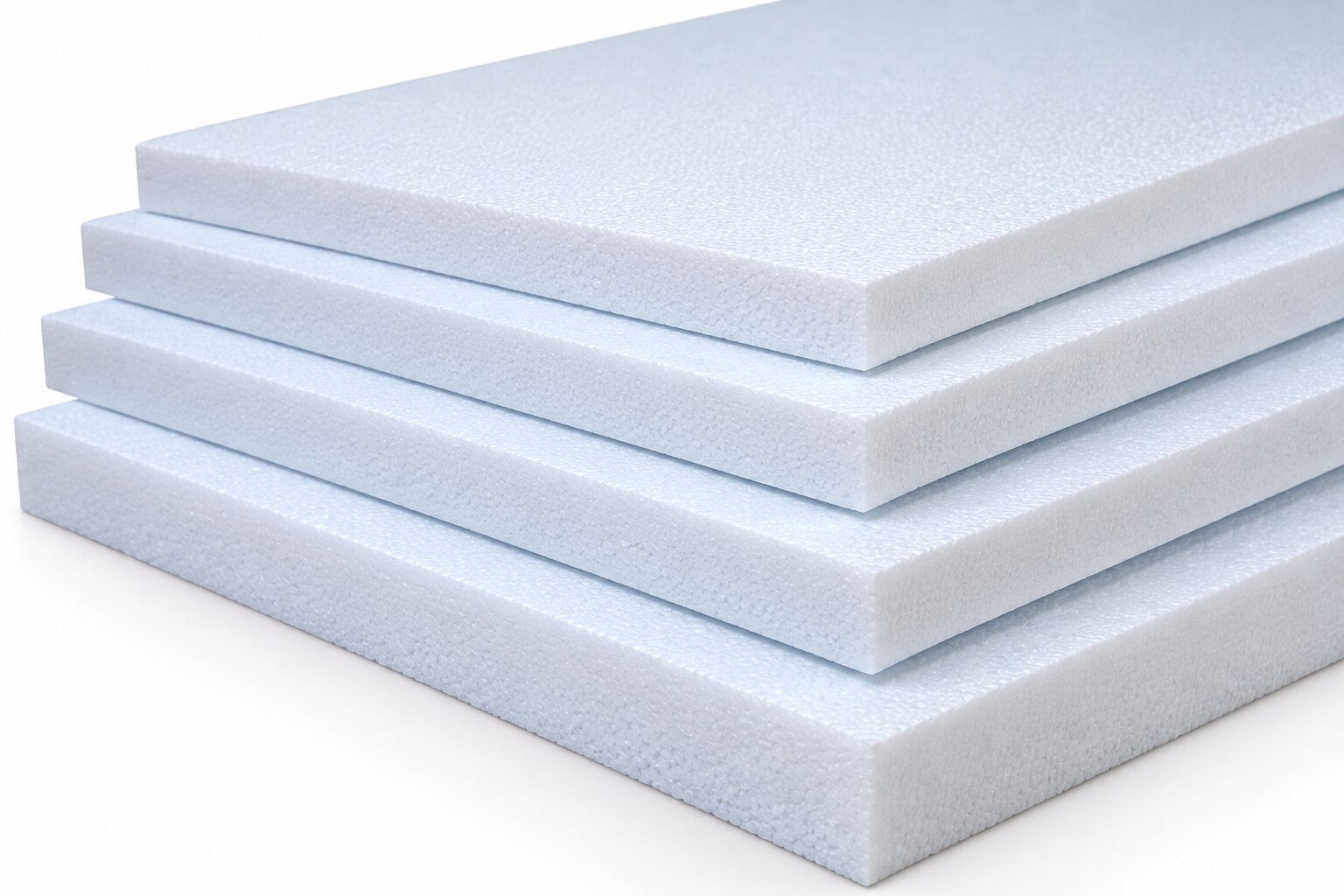
A supplier must identify the board as XPS, EPS or another material before you compare quotations. “Cross linked polystyrene” is used loosely in construction purchasing; the commonly specified rigid closed-cell board is extruded polystyrene foam, or XPS. Expanded polystyrene, or EPS, is manufactured differently and is not an automatic substitute.
| Board | Manufacturing process | Procurement implication |
|---|---|---|
| XPS | Extruded foam | Check claimed IS 16089 compliance for factory-made XPS, including edition and covered thicknesses |
| EPS | Expanded beads | Do not treat it as equivalent without matching moisture, dimensional, load and assembly evidence |
For a cross linked polystyrene supplier in Delhi, require a datasheet stating:
- Material designation, manufacturing process and closed-cell content
- Applicable standard and edition, plus any IS 16089 claim and supporting test reports
- Sheet length and width, available thicknesses, thickness tolerance, density or grade
- Compressive strength at 10% deformation and long-term compressive creep or design-load data
- Water absorption after the named test, dimensional stability and service-temperature range
- Declared or design thermal conductivity at a stated mean temperature
- Edge profile, facing and batch number
A lower initial conductivity does not guarantee lower installed heat flow. Temperature, thickness, density and blowing-agent aging change design values.
Do not replace XPS with EPS where the specification depends on moisture exposure, dimensional stability, compressive behaviour or a tested assembly. This evidence also matters when comparing cross linked polystyrene sheets in Delhi.
Choose the board grade for the actual load, moisture and location
Choose the board grade by matching the actual load, moisture exposure and location—not by accepting “high-density” as a specification.
| Application | Evidence to require | Detail that prevents failure |
|---|---|---|
| Roof slabs | Thermal value, compressive strength and creep data | Continue insulation around parapets, slab edges, outlets and penetrations; gaps become thermal and water paths. |
| Wall cavities | Thickness tolerance, dimensional stability and moisture-control detail | Fit the board without compression and keep the cavity detail, flashings and drainage path clear. |
| Under-floor insulation | Long-term compressive creep or design-load data | A compressive result at 10% deformation alone does not establish a safe sustained floor load. |
| Cold rooms | Specified service-temperature range and thermal design value | Fit joints tightly and coordinate a continuous vapour-control layer; warm, wet air entering joints can cause condensation. |
| Foundations | Below-grade water absorption from the relevant immersion or diffusion test | Use compatible tanking and drainage, then protect boards from backfill damage. |
For point-load areas, request compressive strength, creep data and load-spreading details. A quotation for cross linked polystyrene sheets in Delhi that says only “high-density” gives you no usable design basis.
Low water absorption is not waterproofing. Membranes, damp-proofing, drainage, joints, penetrations and edge detailing still control water ingress.
Do not substitute EPS or a general-purpose board where the design depends on tested load, temperature, moisture, thickness or a fire assembly. Rigid XPS is chosen for thermal and compressive performance, not automatically for acoustic absorption; request measured absorption or transmission-loss data before specifying it for sound control.
Install the boards with compatible adhesives, protection and fire details
Cut XPS boards cleanly and squarely, fit them without gaps, and protect every exposed surface until the permanent facing or waterproofing is installed. Small gaps, crushed edges and discontinuous insulation create thermal bridges that laboratory conductivity values do not capture.
1. Use a fine-toothed saw or an XPS-suitable hot-wire method. Remove damaged edges before installation; do not hide crushed corners behind render or membranes.
2. Fit boards tightly, stagger joints between adjacent rows, and avoid four-way intersections. Continue the insulation through corners, parapets, slab edges and around fasteners without leaving uninsulated strips.
3. Seal open joints and service penetrations with a product confirmed compatible with XPS. Keep thinners, solvent-containing adhesives, incompatible sealants and hot-applied materials away unless the manufacturer gives written approval.
4. Obtain written compatibility confirmation for cement renders, concrete, roof membranes, vapour barriers, tanking systems, waterproofing compounds and mechanical fixings. Low water absorption does not replace membranes, drainage or penetration detailing.
5. Shield exposed boards from ultraviolet light, rain, impact and site traffic using the specified temporary covering. Install the permanent layer promptly; closed-cell foam is not weatherproof storage.
XPS is combustible polymeric insulation, not inherently fire-resistant. Request the exact surface-burning result, such as the ASTM E84 flame-spread and smoke-developed classification where applicable, plus the tested wall or roof assembly classification and its required facing, render, gypsum lining or other protection.
ASTM E84 alone does not prove a fire-resistance period, and unprotected boards are not automatically acceptable behind an occupied-room lining.
Compare cross linked polystyrene price in Delhi on an equivalent basis
Per-sheet quotations differ because boards with different dimensions, thicknesses and strength grades are being compared. For a meaningful cross linked polystyrene price in Delhi, ask every supplier to quote identical specifications.
| Quote field | What to match |
|---|---|
| Length and width | Exact sheet dimensions and total quantity |
| Thickness and grade | Required thickness plus density or compressive-strength class |
| Construction details | Edge profile and facing, if specified |
| Commercial basis | Ex-warehouse or delivered, with delivery point stated |
Normalize each offer to rupees per square metre at the specified thickness or rupees per cubic metre. Record GST, freight, unloading and cutting charges separately. A cheaper sheet is not cheaper if it is thinner, smaller, weaker or delivered with crushed edges.
Before you pay an advance to buy cross linked polystyrene in Delhi, request:
- Technical data sheet, test reports and a physical sample
- Invoice specification confirming dimensions, grade, batch or lot number, thermal conductivity, water absorption, dimensional stability, fire classification and installation guidance
- Stock confirmation for the required thickness, minimum order quantity, packaging, lead time and replacement terms for crushed or wet boards
- Written confirmation that a truck can reach the project gate and unloading area
Inspect packaging for punctures, compression, water exposure and prolonged outdoor storage. Closed-cell construction does not permanently protect boards from ultraviolet exposure or weather. Confirm that certificates accompany the shipment and that the supplied batch matches the approved sample.
Use a supplier checklist before you release the purchase order
Build a one-page comparison sheet before releasing a purchase order. Record the required thickness, board dimensions, quantity, load condition, service temperature, moisture exposure, fire protection and delivery date.
| Field | Accept | Reject |
|---|---|---|
| Material | XPS or confirmed alternative, manufacturing process, grade and standard named | “Thermal insulation board” only |
| Evidence | IS 16089 edition where claimed, test reports and batch number | Generic certificate with no product identification |
| Performance | Thickness tolerance, strength class, design conductivity and named water-absorption test | 10% deformation strength presented as the allowable long-term load |
| Supply | Approved sample matched to the shipment batch; certificates travel with it | Mixed batches without written approval |
| Logistics | Stock verified physically or by dated warehouse photographs; access, unloading and storage agreed | Unverified stock or unclear unloading responsibility |
Ask how the cross linked polystyrene insulation supplier handles short delivery, crushed or wet packaging, mixed batches and replacement claims. In Delhi, confirm that boards were protected from ultraviolet exposure and weather; closed-cell construction does not make outdoor storage harmless.
Shiv Sales Corporation can support a sound comparison by providing the specification sheet, sample, batch documentation and written application recommendation with its commercial quote.
Write the purchase order precisely: identify XPS or the confirmed alternative, IS 16089 reference, length, width, thickness and tolerance, strength class, design conductivity, water-absorption test, fire documentation, quantity, GST, freight, delivery date and acceptance procedure. Do not release an advance against a trade name alone.
Related product
 | Cross Linked Polystyrene In modern construction and insulation industries, selecting the right material is essential for energy efficiency and long-term durability. View product → |
Frequently asked questions
How do you confirm whether a quotation is for XPS or EPS?
Check the technical datasheet, product label and invoice for the material name, manufacturing method, thickness, density and compressive strength. XPS is extruded polystyrene foam with a more uniform closed-cell structure; EPS is expanded from beads and is not an automatic substitute.
How do you choose a polystyrene board grade for a construction project?
Match the board’s compressive strength to the imposed load, then check water absorption, thickness, service temperature and location. Roofs, floors, foundations and walls have different moisture and loading conditions, so do not select by thickness alone.
What installation details must you confirm before buying polystyrene sheets?
Confirm that the adhesive is compatible with polystyrene and contains no solvent that attacks the foam. Specify joints, mechanical fixing where required, a protective screed or facing, drainage details and the fire-rated build-up for the complete assembly.
How should you compare cross linked polystyrene price in Delhi?
Compare identical material types, thicknesses, dimensions, compressive-strength grades and quantities. Add GST, cutting, packing, transport, unloading, lead time and replacement terms so each quotation shows a comparable delivered cost.
Keywords