

Condensation failures rarely come from choosing the wrong foam alone; they start with mismatched thickness, unsealed joints, compressed supports, or missing performance evidence. By the end, you will be able to specify the material, measure the order accurately, compare alternatives, and check whether a Delhi supplier can support the installation with the required documents and accessories.
Key takeaways
- Match thickness to temperature, condensation risk, location and outdoor exposure.
- Ask for the datasheet, batch number, test reports and supplier licence before payment.
- Seal every longitudinal joint, butt joint, hanger and penetration against vapour entry.
- Choose mineral wool, XPS or polyurethane when fire, compression or temperature demands dominate.
What the closed-cell structure proves—and what the datasheet must prove
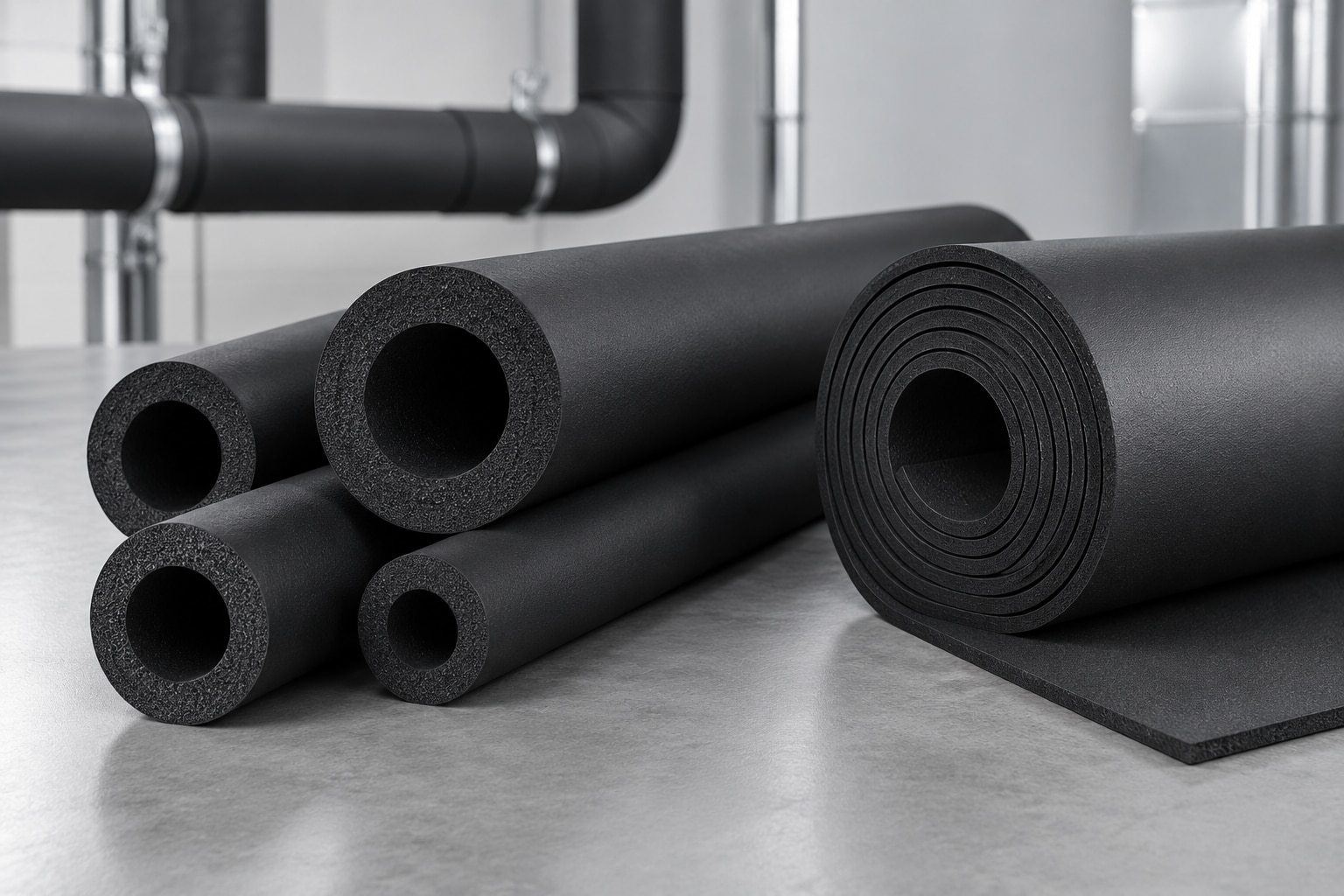
Small, sealed cells in NBR/PVC elastomeric foam slow heat flow and restrict liquid-water uptake and water-vapour entry. That structure explains why closed-cell insulation suits chilled-water pipes, refrigeration lines and air-conditioning ducts; it does not prove the performance of a particular product.
Ask for a datasheet that states:
- Thermal conductivity (lambda) at a declared mean temperature and test method
- Operating-temperature range
- Water-vapour transmission or permeability, plus water absorption
- Density, available thicknesses and dimensional tolerances
- Fire classification and the standard used for testing
Do not compare lambda values from different datasheets until the reference temperature and test method match. Conductivity changes with mean temperature, density, cell structure and thickness, so a lower headline value may not represent better service performance.
ASTM C534, the specification for preformed flexible elastomeric cellular thermal insulation in sheet and tubular form, provides a useful material benchmark.
For condensation risk, use ASTM C680 or verify a calculation based on fluid temperature, ambient temperature, relative humidity, pipe or duct geometry, surface coefficient, insulation thickness, conductivity and vapour resistance. A foam label alone cannot predict sweating.
A low flame-spread result under ASTM E84 describes surface-burning behaviour; it is not a time-rated fire-resistance assembly. EN 13501-1 reaction-to-fire classifications serve a different purpose. Treat nitrile insulation in Delhi as a technical grade to verify against project conditions, not as a generic material label.
Select thickness for Delhi pipes, ducts, refrigeration and outdoor service
Choose thickness to stop surface condensation first, then confirm the thermal target. A Delhi design check needs fluid temperature, design relative humidity, surrounding air temperature, pipe or duct size, surface coefficient, insulation conductivity, and continuity of the vapour seal. Calculate or verify the result under ASTM C680, not from a universal thickness table.
Use these inputs before approving a thickness:
- Chilled-water pipes: check the larger surface area and every size change.
- Refrigeration lines: account for small diameters, cold fluid, bends, and oil-compatible sealing.
- Air-conditioning ducts: check duct dimensions, corners, seams, access panels, and the external surface.
- Indoor installations: add protection against impact, tools, and maintenance damage.
A matching nominal thickness does not make every detail equivalent. Valves, flanges, bends, supports, and penetrations need shaped pieces and sealed joints; a support can compress the foam and create a cold bridge. Stretching tube insulation around a bend also reduces its wall thickness.
Rooftop or outdoor service needs a UV-resistant coating, jacketing, or another weatherproof finish. Closed cells limit moisture uptake, but they do not prove ultraviolet, mechanical, or long-term weathering resistance. Ask a closed cell nitrile insulation supplier in delhi to verify the complete assembly, including the finish and vapour-seal continuity.
Measure the order and verify the supplier documents before payment
Measure the job before requesting prices. For tubes, record pipe outside diameter, required insulation thickness, tube inner diameter, length, bends, valves, flanges, supports, penetrations, and the quantity of each size. For sheets or rolls, record duct width, height, perimeter, sheet thickness, roll width, joint locations, access panels, and cutting allowance.
| Form | Record before ordering | Common omission |
|---|---|---|
| Tube | Outside diameter, inner diameter, length, thickness, quantity by size | Bends, valves, flanges, supports and penetrations |
| Sheet | Duct width, height, perimeter, thickness and joint locations | Access panels and cutting allowance |
| Roll | Roll width, required length, thickness and joint locations | Extra material for cuts and waste |
Your quotation must state:
- Tube, sheet or roll form; dimensional tolerances; quantity by size; and delivery condition.
- Adhesive and sealant system, service-temperature range, vapour-seal requirements, fire classification, and the exact fire test standard.
- Compatibility of the adhesive with the foam, substrate, operating temperature and project cleaners.
Before payment or acceptance, check printed product thickness and dimensions, batch number, manufacturing date, technical datasheet, thermal and vapour test reports, fire documentation, adhesive compatibility, and intact packaging. A closed cell nitrile insulation supplier in Delhi should provide batch-identifiable evidence, not density alone.
Shiv Sales Corporation is a Delhi sourcing option when the buyer verifies that evidence and matches every quoted size and accessory to the project schedule before deciding where to buy nitrile rubber insulation.
Related product
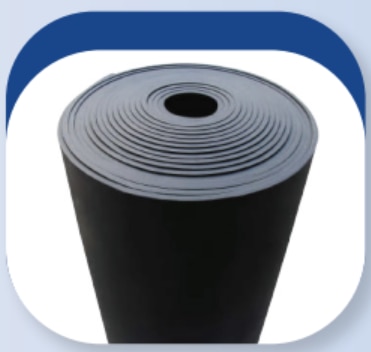 | Nitrile Insulation – Closed-Cell Thermal & Acoustic Insulation Nitrile Insulation – Closed-Cell Thermal & Acoustic Insulation Nitrile Insulation from Shiv Sales Corporation is a high-quality closed-cell elastomeric insulation designed for superior thermal efficiency and... View product → |
Install a continuous vapour seal instead of relying on foam alone
Closed-cell foam does not prevent sweating by itself. A single open seam or puncture lets humid air reach the cold metal, where condensation forms beneath the insulation and remains hidden.
1. Prepare the surface before fitting. Make the pipe or duct clean, dry, sound and corrosion-free; remove oil, dust, loose scale and moisture. Do not cover wet pipework, because trapped water can corrode the metal and undermine adhesion.
2. Measure and cut tubes or sheets accurately. Keep the foam relaxed rather than stretched around bends, and leave no gaps at cuts, joints or changes in size.
3. Apply only the manufacturer-approved adhesive to longitudinal seams. Seal every butt joint continuously, including joints at bends, valves, flanges, supports and penetrations. An unsealed end is a vapour path.
4. Confirm adhesive compatibility with the foam, metal or other substrate, operating temperature, refrigerant oil, cleaning chemicals and any coating touching the insulation. A substitute adhesive can soften the foam or release from the surface.
5. Prevent mechanical damage during installation. Do not crush the foam at supports or force it against sharp edges; use saddles or load-spreading details where the design specifies them. Compression creates thin spots that become condensation points.
6. Inspect before closing a ceiling or cladding. Check continuous contact, sealed seams and ends, intact vapour barriers, protected supports, and protection from sunlight and impact. Repair every cut or puncture before concealment.
Compare nitrile with mineral wool, polyethylene, XPS and polyurethane by project risk
A flexible nitrile tube is not a substitute for every insulation system. Select it when condensation control, curved coverage, and resistance to oils or many petroleum-based fluids outweigh the need for high fire resistance, rigid boards, or airborne sound isolation.
| Option | Main comparison | Choose when |
|---|---|---|
| Nitrile rubber | Flexible, sealed-cell, moisture-resistant; needs sealed joints and compatibility checks; acoustic benefit is mainly breakout and structure-borne noise | Pipes, ducts, bends, supports, and cold services where condensation control matters |
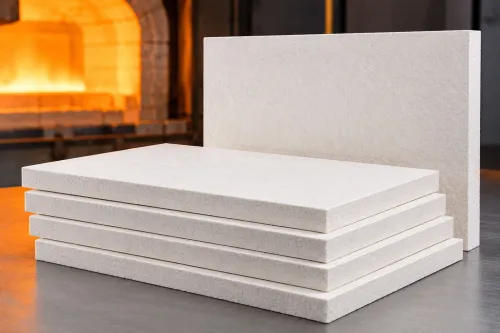
| Glasswool or rockwool | Strong fire performance and sound absorption; fibrous material needs a vapour barrier or facing in wet or chilled applications; less flexible and more vulnerable to compression | Fire-sensitive rooms, plant areas, and absorption targets where space permits |
| Polyethylene | Flexible and moisture-resistant, but temperature range, fire classification, joint sealing, and cost depend on grade | Basic pipe protection where service temperature and fire requirements are modest |
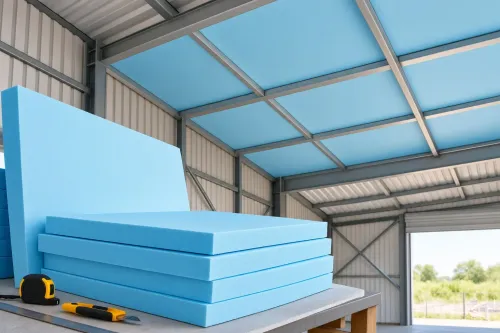
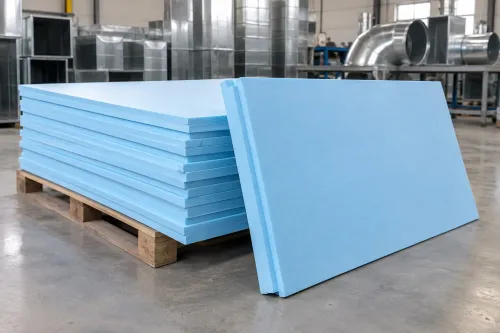
| XPS | Rigid board with useful thickness control; suited to flat ducts, walls, and floors, not complex pipe geometry | Board stiffness and impact resistance matter more than flexible coverage |
| Polyurethane | Rigid or spray-applied form with strong thermal performance; joints, dimensional stability, and fire documentation require close review | High thermal resistance in shaped panels or engineered systems |
Confirm compatibility with refrigerant oil, adhesives, sealants, coatings, and cleaners before approving nitrile. Its low mass does not make it an airborne acoustic barrier.
A specification for thermal acoustic insulation in Delhi must name insertion loss or sound absorption, not just “acoustic.” Match the final system to moisture, fire, acoustic, space, temperature, and lifecycle-cost risks.
Frequently asked questions
What does a closed-cell structure prove about nitrile insulation?
It indicates a foam structure designed to slow heat flow and restrict liquid-water uptake and vapour entry. It does not prove a product’s actual thermal conductivity, water-vapour transmission, fire performance, temperature range or dimensional stability; check the datasheet and test reports.
How do you select nitrile insulation thickness for Delhi projects?
Select thickness using the pipe or duct temperature, ambient temperature and humidity, surface emissivity, indoor or outdoor location, condensation limit and required heat-flow control. Chilled-water and refrigeration systems need enough thickness to keep the outer surface above the dew point, while outdoor service also needs UV protection and weatherproofing.
Which supplier documents should you verify before buying nitrile insulation?
Request the current technical datasheet, product specification, batch or lot number, dimensions, temperature range, thermal-conductivity values, water-vapour transmission data, fire-test classification and test reports. Match the documents to the delivered packaging, and check the supplier’s invoice and business-registration or licence details before payment.
Why is a continuous vapour seal necessary with closed-cell foam?
Foam cells alone do not seal open joints, cuts, hangers, valves or penetrations. Apply compatible adhesive or vapour-seal tape at longitudinal and butt joints, close every discontinuity, and protect the finished surface from damage and water entry.
When should you compare nitrile insulation with mineral wool, polyethylene, XPS or polyurethane?
Compare them by project risk rather than by material name. Mineral wool suits applications where fire resistance and high-temperature capability lead; polyethylene suits selected low-moisture and impact conditions; XPS suits rigid board applications; polyurethane suits projects prioritising low thermal conductivity. Verify each material’s fire, moisture, temperature, compression and installation requirements.