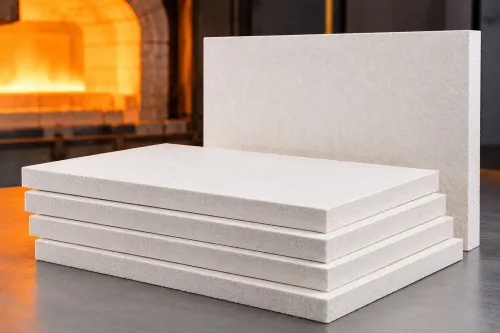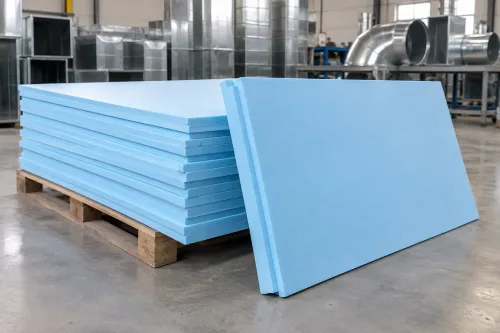
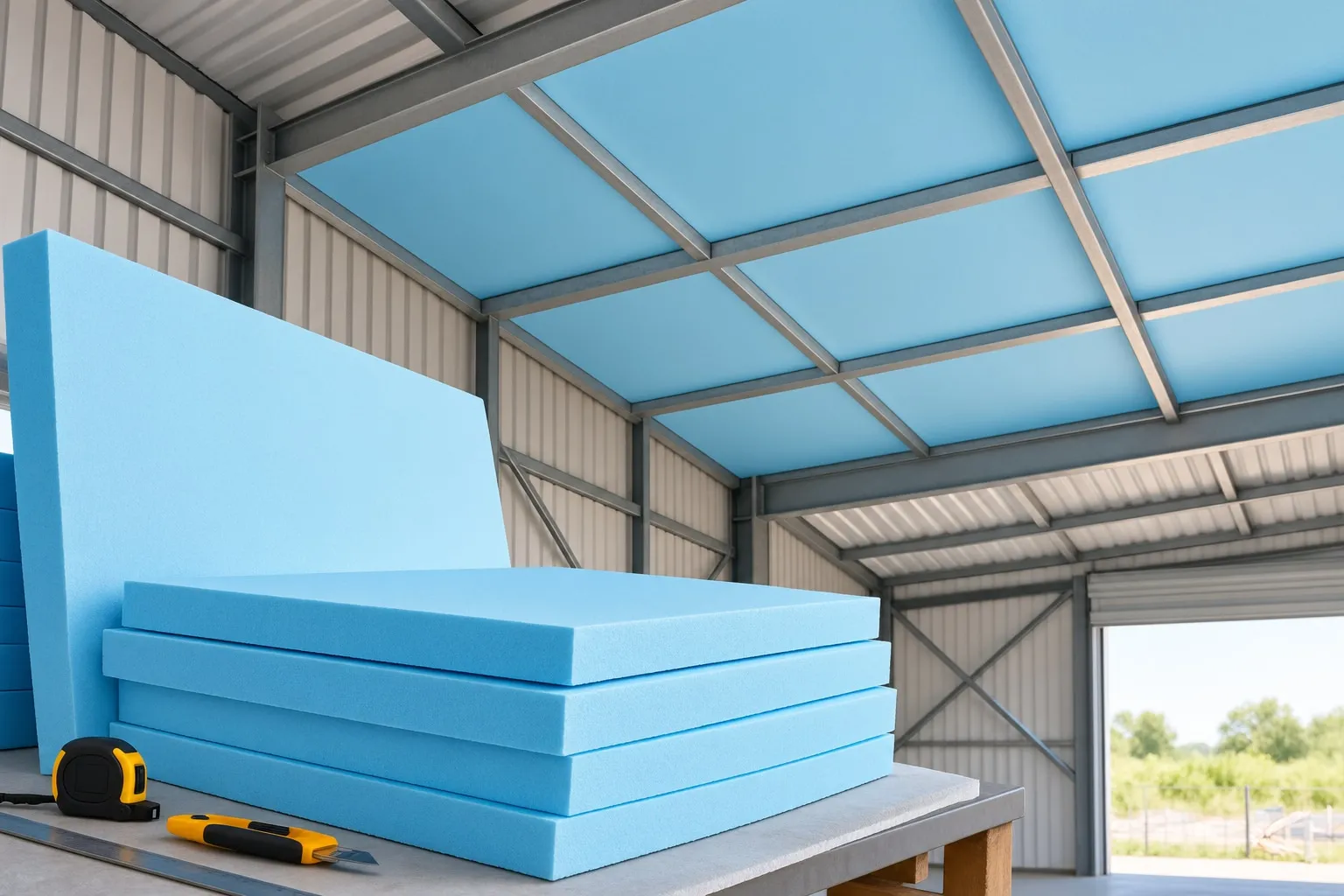
A shed loses heat through its roof, walls, floor, joints, doors, and metal framing, so installing boards in only one convenient space often produces disappointing results. By the end, you will know how to measure the shed, choose a practical XPS thickness, install it without open joints, and protect the assembly from condensation, fire, sunlight, and noise problems.
Key takeaways
- Insulate the roof first when Delhi’s metal shed overheats in direct sun.
- Measure each surface and allow for framing, doors, vents, and service gaps.
- Fit XPS boards tightly, then seal joints before installing the interior lining.
- Use a vapour-control strategy to limit condensation behind the lining.
Decide Which Shed Surfaces Need Insulation First
In Delhi, start with the roof: solar radiation can turn a metal roof into the shed’s dominant summer heat source. Heat then crosses the enclosure by conduction, air leakage, and radiation, so extruded polystyrene sheets for shed insulation work best as part of a complete roof, wall, or floor assembly.
| Surface | Prioritise when | Practical approach |
|---|---|---|
| Roof | Always assess first in a metal shed, especially under strong sun | Combine XPS with a light-coloured outer roof, reflective radiant-control layer, or ventilated cavity where the design permits. |
| Walls | The shed is occupied, air-conditioned, or faces strong afternoon sun | Use continuous coverage where possible and seal joints, edges, and penetrations. |
| Floor | The shed sits on a slab, raised supports, or damp ground | Insulate beneath a load-spreading finish when goods, machinery, or workers need a steadier internal temperature. |
For walls and roofs, XPS fitted only between steel or timber members leaves thermal bridges through the framing. A continuous layer across the framing reduces those bridges. With shed insulation sheets beneath a floor, select the board from dead load, shelving-leg loads, machinery point loads, and long-term creep data—not short-term compressive strength alone.
XPS controls heat, not sound. Its closed-cell structure is not a substitute for mineral wool or APF board with documented acoustic performance, such as an NRC or STC result.
Measure the Shed and Choose a Board Thickness
Measure every surface before buying shed insulation sheets: record the inside length and width of the roof, each wall, and the floor, then record the actual length and width of one board.
Calculate each surface area, subtract doors and windows, and deduct openings that will remain uninsulated. Measure the areas between studs or purlins separately from continuous surfaces; framing spacing changes both cutting requirements and thermal bridging.
Add the roof overlap, eaves, ridge, and perimeter returns required by your chosen detail. Divide the adjusted area by one board’s coverage, round up for cuts, and keep a separate allowance for crushed or damaged edges. Do not bury damaged boards inside the area calculation.
| Board option | Compare by | Main trade-off |
|---|---|---|
| 25 mm | Declared or design thermal resistance | Least space and cost, but less heat-flow reduction |
| 40 mm | Declared or design thermal resistance | Moderate performance and thickness |
| 50 mm | Declared or design thermal resistance | Better resistance, but higher cost and space use |
| Thicker board | Declared or design thermal resistance | Greater resistance, but may not fit the frame and lining |
Design values account for ageing, temperature, moisture, and installation, so thickness alone is a poor comparison for extruded polystyrene insulation in Delhi. A thinner continuous layer across framing can outperform a thicker board fitted only between members. Reserve space for the vapour-control layer, service cavity, and fire-protective lining when calculating the finished interior size.
Install XPS on the Roof, Walls, and Floor Without Open Joints
A clean, dry substrate and accurately fitted boards are the foundation of effective extruded polystyrene sheets for shed insulation. Check that studs and purlins are straight before cutting; a crooked frame creates gaps that no finish layer can reliably correct.
1. Plan the fixing layout around studs, purlins, doors, windows, pipes, conduits, vents, and corners. For metal framing, install a continuous XPS layer across the framing when the assembly permits it, then add between-frame pieces where greater thickness is specified.
2. Cut each board to fit its opening. Do not force an oversized board into an irregular space: compression can distort it. An oversized gap creates an air path, so frame larger penetrations or seal them with compatible materials.
3. Fix the shed insulation sheets with fasteners and washers designed for the substrate, or use adhesive explicitly approved for XPS and the adjacent painted steel, membrane, or treated timber. Never use solvent-based adhesive, fuel, oil, or an untested sealant.
4. Butt board edges tightly. When using two layers, stagger the joints so one layer does not align with the other. Seal remaining gaps with compatible low-expansion foam or XPS-approved tape, including around screws, pipes, vents, doors, and windows.
5. On floors, provide continuous support beneath every board and confirm that the finished floor spreads shelving and machinery point loads rather than concentrating them.
6. Cover exterior XPS promptly with the specified membrane, cladding, render system, or other approved protection. Prolonged sunlight degrades exposed board surfaces; friction-fit boards and uncovered sheets are not finished installations.
Control Condensation and Protect the Interior Lining
Foam against a steel sheet does not, by itself, stop condensation. Warm, humid air can pass through sheet laps, ridge details, fasteners, wall joints, and service penetrations, then meet the cold underside of the metal.
1. Build a continuous air and vapour-control layer where the roof or wall assembly requires one. Tape or seal its laps, perimeter edges, screws, pipes, vents, doors, and windows; an unsealed gap can defeat otherwise well-fitted extruded polystyrene insulation in Delhi.
2. Detail the roof, wall, and floor junctions as one envelope. Continue the boards or control layer across corners and perimeter edges, close gaps with compatible low-expansion foam or XPS-approved tape, and use a ventilated cavity or another documented condensation-control strategy. Ventilate for occupants and moisture without creating openings that bypass the insulation.
3. Protect the lining, not just the insulation. XPS is combustible and can produce dense smoke and toxic combustion products during a fire, so never leave it exposed as the finished interior surface of an occupied shed. Install the code-compliant lining or covering specified for the product and local rules.
4. Before fixing boards, check the product’s fire classification, service-temperature range, and approved lining system. Keep XPS away from heaters, welding, electrical ignition sources, and hot flues; a protective lining does not make unsafe clearances acceptable.
Compare Products Before Buying Shed Insulation Sheets in Delhi
Do not choose shed insulation sheets from thickness alone. Ask a polystyrene insulation supplier in Delhi for documents and values that match your roof, walls, or floor loading.
- Product data sheet with declared or design thermal resistance at its stated temperature
- Compressive-strength grade and long-term design load for floor use; common XPS grades range from about 200 kPa to 700 kPa or more
- Water absorption, dimensional stability, fire classification, and service-temperature range
- Board length, width, thickness, and edge profile
- Batch identification, adhesive compatibility, and approved fixing method
Compare products on the figures that affect your assembly:
| Product detail | Why it matters | What to compare |
|---|---|---|
| Thermal resistance | Design value accounts for temperature, ageing, moisture, and installation | Declared or design R-value at the stated temperature |
| Compressive strength | Floor boards face shelving legs, machinery, and long-term creep | Grade plus long-term design load, not short-term strength alone |
| Water and fire performance | Moisture resistance does not make XPS non-combustible | Water absorption result and fire classification |
| Fit and durability | Gaps, warped boards, and crushed edges create thermal and air-leakage paths | Dimensions, edge profile, dimensional stability, and service temperature |
Higher strength does not automatically improve thermal, fire, or acoustic performance. Confirm that the exact board works with the adhesive, tape, fasteners, membrane, and protective lining.
Shiv Sales Corporation belongs in your comparison with other Delhi suppliers when you need extruded polystyrene insulation in Delhi and related construction materials. Ask how the proposed assembly handles Delhi’s roof solar exposure, ventilation, air leakage, condensation, and internal lining—not just what the board is called.
Related products
 | Extruded Polystyrene Sheets Shiv Sales Corporation offers high-quality and cost-effective extruded polystyrene foam designed to meet various insulation requirements. View product → |
 | Extruded Polystyrene Sheet (XPS Board) – High-Performance Thermal Insulation Extruded Polystyrene Sheet (XPS Board) – High-Performance Thermal Insulation XPS Board from Shiv Sales Corporation is a rigid, moisture-resistant thermal insulation sheet designed for roofs, walls, floors, and foundation... View product → |
Frequently asked questions
Which shed surface should you insulate first?
Start with the roof when solar heat makes the metal roof the shed’s dominant summer heat source. Insulate walls next, then the floor when ground heat, cold surfaces, or stored contents require it.
How do you choose XPS thickness for a shed?
Measure the available cavity depth and account for framing, doors, vents, and the interior lining. Choose a board thickness that fits without compressing the sheet or blocking ventilation, and compare the stated thermal resistance rather than thickness alone.
How do you install XPS sheets without open joints?
Cut boards to fit tightly between framing members, stagger joints where multiple layers are used, and seal gaps with compatible low-expansion foam or insulation tape before covering the boards.
How can you control condensation behind shed lining?
Stop humid air reaching cold surfaces by sealing board joints, penetrations, roof edges, and wall-to-floor junctions. Keep the interior lining dry and provide ventilation where the shed design requires it.
Keywords