Choosing XPS for HVAC work requires more than comparing board thickness or a quoted price. You will be able to match the board to its location, temperature, fire and condensation requirements, then evaluate a Delhi supplier’s documents, delivery and installation support before placing an order.
Key takeaways
- Use XPS where moisture resistance and compressive strength matter.
- Specify thermal performance, compressive strength and water absorption—not thickness alone.
- Seal every joint and protect exposed board edges from damage and moisture paths.
- Check board dimensions, batch details, damage and storage conditions before installation.
Where XPS Works in an HVAC Installation—and Where It Does Not
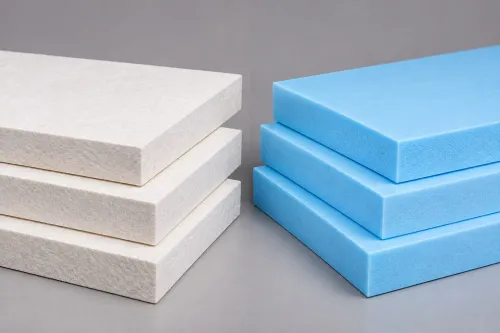
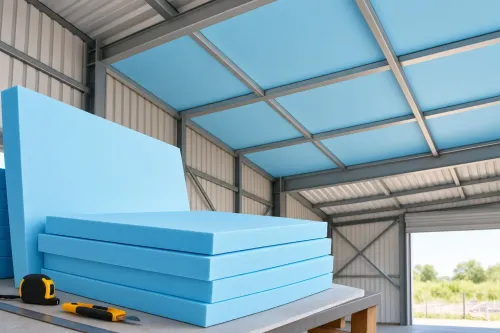
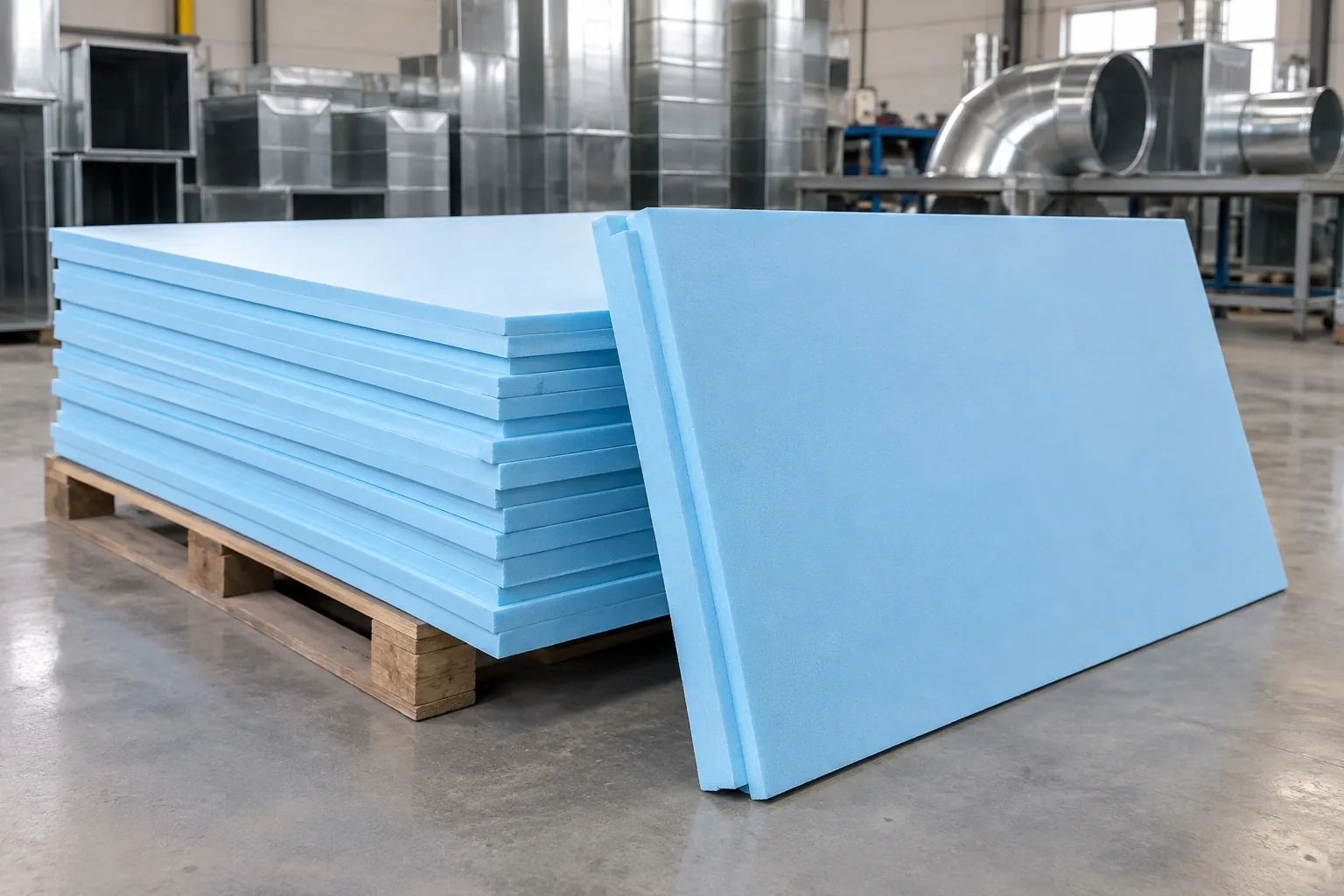
Use XPS for exterior rectangular ducts, protected rooftop duct routes, plant-room floors, equipment bases, service platforms, and buried or below-grade assemblies where moisture resistance and compressive strength matter. An xps board for hvac insulation is rigid, so installers must cut it accurately, protect its edges, and seal every joint.
| Option | Best fit | Main limitation |
|---|---|---|
| XPS | Rigid duct exteriors, floors, bases, buried work | Combustible; poor for curves, sound absorption, and unprotected exposure |
| Nitrile insulation | Chilled-water pipe bends and condensation control | Less suitable for load-bearing floor or base applications |
| PIR or phenolic board | High thermal performance where thickness is restricted | Fire classification and installation details still require verification |
| Mineral wool | Non-combustible assemblies and acoustic absorption | Needs moisture protection and careful joint detailing |
| EPS | Lower-cost protected construction | Lower moisture and fire performance must fit the specification |
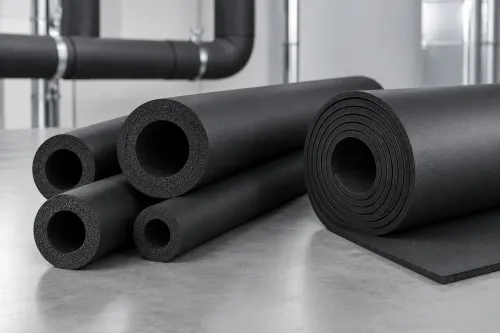
Choose nitrile for curved pipes, flexible ductwork, complex fittings, and exposed equipment connections. XPS does not bend around these shapes; gaps create thermal bridges and vapour paths.
Do not use XPS around:
- Hot-air ducts, flues, boilers, or high-temperature surfaces
- Solvents or unprotected sunlight
- Locations requiring a non-combustible tested assembly
- Applications needing acoustic absorption or a tested fire-rated duct system
XPS is combustible plastic foam, not a universal fire-resistant or acoustic product. Keep equipment access panels operable and preserve manufacturer-specified service clearances; covering either one turns a suitable insulation choice into a maintenance failure.
How to Specify XPS Board by Performance, Not Thickness Alone
Approve thickness only after calculating the required heat flow. Check operating temperature, required surface temperature, condensation criterion, support spacing, and the applicable energy code or project specification; a generic R-value per inch is not enough.
Request product identification against ASTM C578 or EN 13164, then compare the submittal with the minimum evidence required:
| Item | Weak submittal | Acceptable submittal |
|---|---|---|
| Thermal value | Generic R-value per inch | Declared thermal conductivity at a named mean temperature, with stated ageing or conditioning |
| Mechanical value | Density only | Compressive strength at a stated deformation, plus density |
| Fire value | “Fire resistant” claim | Reaction-to-fire classification, test standard, smoke data, and proposed thermal barrier or fire-stopping arrangement |
Require these product details in the material schedule:
- Water absorption, dimensional stability, thickness tolerance, sheet length and width
- Edge profile, surface finish, facing, and permitted adhesive system
- Maximum service temperature and the intended HVAC location
Do not approve the board near chilled-water systems, refrigeration lines, heating equipment, or hot-air ducts until its maximum service temperature is checked against the actual surface temperature. Density alone does not prove compressive, thermal, or fire performance.
The purchase order must state whether the board serves ducts, equipment bases, floors, roofs, or another assembly, because those uses are not interchangeable. Use xps insulation sheet in Delhi as a procurement search term, not as evidence of compliance.
How to Prevent Condensation and Installation Failures
Keep the cold-side vapour-control layer continuous: low water absorption and vapour resistance do not make an unsealed xps board for hvac insulation condensation-proof. Any gap can let humid Delhi air reach a cold surface and create concealed moisture.
1. Measure each face and cut accurately. Make tight butt joints, stagger joints between layers, and avoid crushed edges; open joints and damaged corners become thermal bridges and vapour-leak paths.
2. Confirm adhesive compatibility before application. Solvent-based products can attack polystyrene. Use the approved adhesive system, add mechanical fixing where specified, and seal joints, corners and equipment connections without leaving voids.
3. Continue the vapour-control layer around supports, hangers, dampers, access doors, flanges and service penetrations. Insulate supports or provide thermal-break details; an uninsulated support conducts heat around otherwise continuous board.
4. Fit edge protection and protective cladding wherever impact, weather or maintenance traffic could damage the board. Seal cladding laps and penetrations so water cannot enter behind the board, then inspect for surface cracking beneath the cladding.
5. Preserve every access panel and manufacturer-required service clearance. Do not bury removable covers under board or cladding. Where the building specification requires protection for combustible foam, install the planned separation, thermal barrier or protective lining; do not improvise with a thin facing.
After installation, check joints with a light and hand inspection, trace any dampness behind the board before recladding, and investigate cracked surfaces rather than sealing over them. XPS does not replace acoustic lining, vibration isolation or a tested duct fire system.
What to Ask an XPS Sheet Insulation Supplier in Delhi Before Ordering
A specialist hvac insulation supplier in Delhi proves suitability with documents, not the label XPS. Request a technical datasheet, safety data sheet, fire test report, quality certificate, batch traceability, installation instructions, and independent or accredited test evidence for thermal conductivity, water absorption, dimensional stability, and compressive strength.
Confirm the test method, conditioning, mean temperature, and deformation used for each value.
| Supplier type | What you receive | Risk to control |
|---|---|---|
| Specialist HVAC supplier | Duct and chilled-system guidance, compatible adhesive advice, samples, batch records, and coordinated delivery | Fewer surprises at joints, supports, and site handover |
| General construction-material dealer | A nominal board description, price, and stock availability | Wrong facing, adhesive, thickness, fire arrangement, or damaged storage |
Put the approved standard, performance values, facing, adhesive system, fire-protection arrangement, and intended use in the purchase order.
Ask for ASTM C578 or EN 13164 identification, sheet length and width, thickness range and tolerance, edge profile, packaging, batch number, sample, cut-to-size availability, minimum order quantity, lead time, Delhi-site delivery, and replacement terms for crushed or warped sheets.
Shiv Sales Corporation belongs on your comparison list only if it supplies those technical submittals, product samples, and delivery terms.
An xps sheet insulation supplier in Delhi that understands ducts, chilled systems, storage, and site coordination offers more value than an unverified dealer because it helps prevent incompatible adhesives, untraceable batches, and boards that arrive unusable.
Related products
 | Extruded Polystyrene Sheet (XPS Board) – High-Performance Thermal Insulation Extruded Polystyrene Sheet (XPS Board) – High-Performance Thermal Insulation XPS Board from Shiv Sales Corporation is a rigid, moisture-resistant thermal insulation sheet designed for roofs, walls, floors, and foundation... View product → |
 | Extruded Polystyrene Sheets Shiv Sales Corporation offers high-quality and cost-effective extruded polystyrene foam designed to meet various insulation requirements. View product → |
How to Calculate, Receive, Store and Inspect the Boards
1. Measure every rectangular duct face separately: length × width, then add the specified overlap, return, or edge detail. Add the face areas, divide by the supplier’s usable sheet area (sheet length × sheet width), and round up to whole sheets. Add a documented cutting allowance from the nesting plan; do not guess waste.
2. Match delivery to the installation sequence so boards are not left on site unnecessarily. Store them flat on a level pallet or floor in a shaded, dry area, away from direct ultraviolet exposure, standing water, fuels, paints, and solvent-based adhesives. If you buy xps insulation sheets, protect the packaging until installation.
3. Before signing, count the sheets and record length, width, thickness, thickness tolerance, edge profile, facing, lot identification, and packaging condition. Reject or quarantine boards with warped faces, crushed corners, cracked edges, wet packaging, missing lot details, or quantity shortages.
4. Recut and seal open joints; replace crushed edges rather than filling them with excessive adhesive. Confirm adhesive compatibility before correcting poor adhesion, because solvents can attack polystyrene. Isolate thermal bridges at supports, and investigate water behind the board before recladding. Reject any board that cannot maintain a continuous vapour-control layer or arrives damaged.
Frequently asked questions
Where does XPS work in an HVAC installation?
Use XPS for exterior rectangular ducts, protected rooftop duct routes, plant-room floors, equipment bases, service platforms, and buried or below-grade assemblies where moisture resistance and compressive strength matter.
Why is XPS thickness alone not enough for HVAC insulation?
Compare the board’s declared thermal performance, compressive strength, water absorption, dimensional stability, fire behaviour and intended application alongside its thickness.
How do you prevent condensation and installation failures with XPS boards?
Cut boards accurately, close gaps, seal every joint, protect edges, and maintain a continuous insulation layer around the duct or assembly. Check vapour-control details where humid air can reach a cold surface.
What should you ask an XPS sheet insulation supplier in Delhi before ordering?
Ask for the technical data sheet, available thicknesses and dimensions, declared compressive strength, water absorption, thermal conductivity, fire-performance information, batch details, packaging, lead time and replacement terms for damaged boards.
Keywords